


Selecting durable plumbing materials determines the long-term safety of any building project in Kenya. Consequently, consulting a reliable GI Pipes and Fittings Guide helps contractors and homeowners avoid costly leaks and premature pipe bursts. Furthermore, choosing certified steel components from trusted local suppliers like Winstar Hardware Limited ensures lasting water supply performance across residential and commercial properties.
Understanding GI Pipes and Fittings in Kenyan Construction
Kenyan construction sites demand tough plumbing materials capable of handling rugged conditions and fluctuating water pressures. Therefore, galvanized iron remains a top choice for external water mains and high-rise risers across the country. Moreover, understanding how these metal pipes perform helps builders make smarter procurement decisions.
#1. What Are Galvanized Iron Pipes?
- Manufacturers coat standard mild steel pipes with a protective layer of molten zinc.
- This hot-dip galvanization process creates a strong barrier against rust and environmental corrosion.
- Additionally, the zinc layer sacrifices itself first if minor scratches occur during site handling.
- As a result, these pipes deliver decades of reliable service in demanding Kenyan climates.
- Furthermore, contractors rely on this GI Pipes and Fittings Guide to verify proper zinc coating standards before installation.
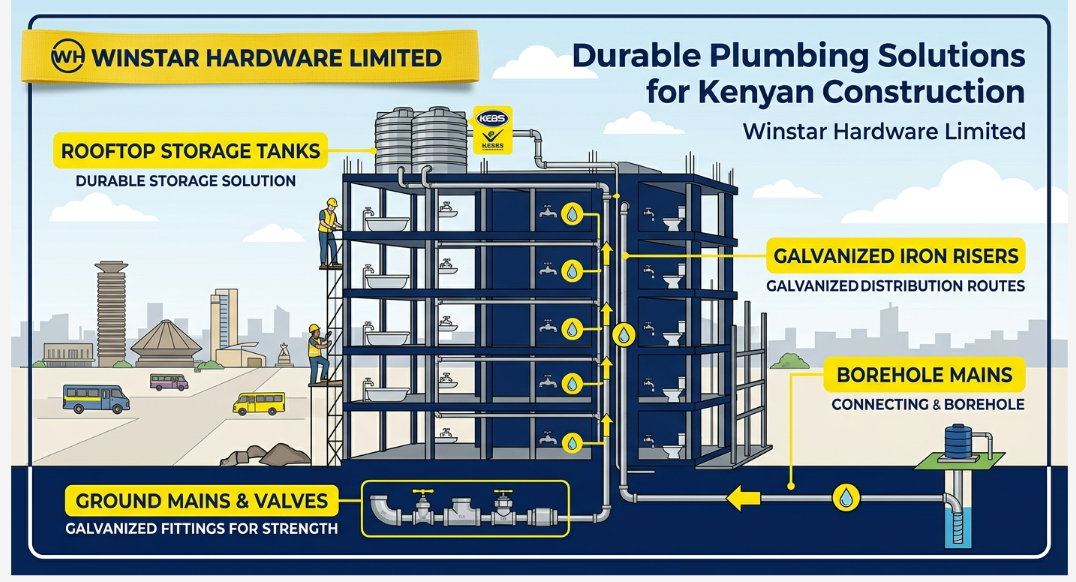
#2. Why Kenyan Builders Prefer GI Over PVC for High-Pressure Lines
- Galvanized steel withstands extreme internal water pressure without swelling or bursting.
- Unlike plastic alternatives, metal pipes resist crushing impacts from falling debris on busy construction sites.
- Moreover, direct tropical sunlight does not weaken or degrade zinc-coated steel over time.
- Consequently, engineers specify galvanized iron for exposed rooftop tank connections and multi-story risers.
- In addition, steel piping provides superior fire resistance for commercial buildings and apartment blocks.
#3. Common Applications in Residential and Commercial Plumbing
- Borehole drillers use heavy-duty galvanized pipes as rising mains to support submersible pumps.
- Similarly, plumbers install them for main water supply lines connecting county meters to storage tanks.
- Factories and warehouses also utilize these pipes for compressed air lines and fire sprinkler systems.
- Meanwhile, farmers depend on rigid metal piping for durable perimeter irrigation lines.
When configuring multi-story building networks, exploring comprehensive flowing solutions for Nairobi and beyond ensures you pair your galvanized pipes with the right valves and fittings
A Complete GI Pipes and Fittings Guide to Sizes and Classes
Buying the wrong pipe diameter or wall thickness leads to poor water flow or dangerous joint failures. Therefore, buyers must match exact pipe specifications to the pressure demands of their specific project. Fortunately, local hardware stores categorize these materials using standardized measurements and color codes.
#4. Navigating Standard Pipe Diameters in Kenya
- Kenyan hardware outlets measure galvanized pipes by their internal nominal bore in inches.
- Half-inch (1/2″) and three-quarter-inch (3/4″) pipes serve individual household taps, sinks, and shower lines.
- Conversely, one-inch (1″) and two-inch (2″) diameters handle main distribution lines for apartments and commercial blocks.
- Larger sizes, ranging from three inches to six inches, support industrial water mains and municipal projects.
- Accordingly, checking a GI Pipes and Fittings Guide prevents mismatches between main supply lines and branch outlets.
#5. Choosing Between Class A (Light), Class B (Medium), and Class C (Heavy)
- Manufacturers produce three distinct wall thicknesses to accommodate varying water pressure levels.
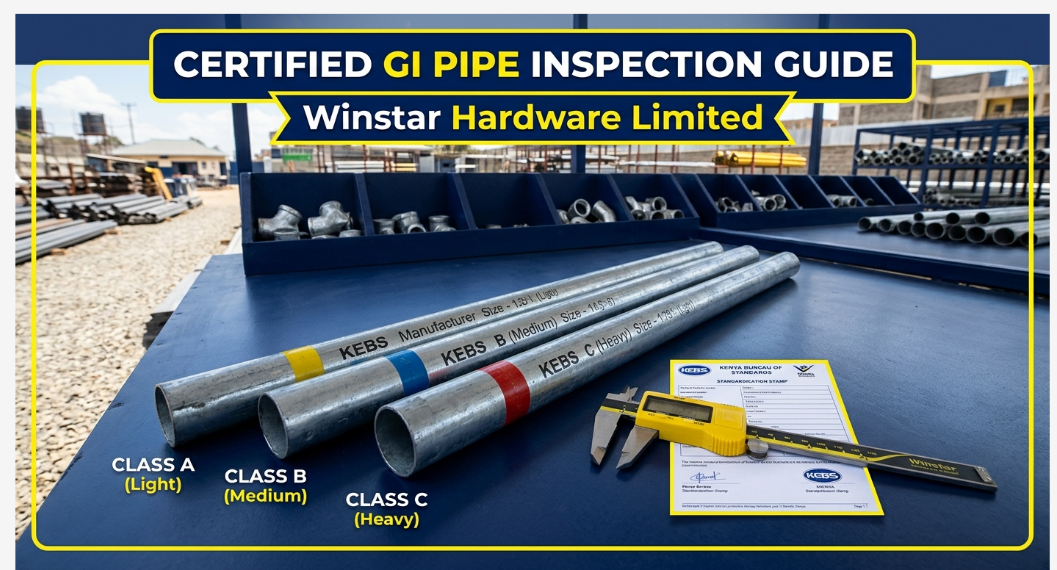
- Class A pipes feature thin walls with brown or yellow color bands for low-pressure domestic tasks.
- By contrast, Class B pipes carry a blue band and offer medium wall thickness for general water mains.
- Meanwhile, Class C pipes display a red band and provide heavy-duty walls for boreholes and industrial pumping.
- Therefore, heavier classes retain superior structural strength after technicians cut threads into the pipe ends.
Using a GI Pipes and Fittings Guide to Match Pipe Class to Water Pressure
- Always select Class B or Class C when installing booster pumps or tall vertical risers.
- Reserve lighter Class A pipes strictly for gravity-fed indoor lines with minimal mechanical stress.
#6. Standard Pipe Lengths and Threading Specifications
- Local mills and importers supply standard galvanized pipes in uniform six-meter lengths.
- Furthermore, most factory-finished pipes arrive with pre-threaded ends and one protective coupling socket.
- Kenyan plumbing standards strictly follow British Standard Pipe (BSP) tapered threading norms.
- Consequently, tapered threads create a tight mechanical wedge as plumbers screw pipes into matching sockets.
- Additionally, referring to a GI Pipes and Fittings Guide helps technicians verify thread compatibility across different brands.
To see a practical demonstration of proper cutting, threading, and tightening techniques, watch this helpful visual guide on how to join GI pipes using fittings.
Essential Components in Every GI Pipes and Fittings Guide
A piping network requires specialized connectors to change direction, branch off, and regulate water flow. Thus, selecting high-grade malleable iron fittings is just as vital as choosing the pipes themselves. Below are the core components every buyer should include on their hardware quotation.
#7. Elbows, Tees, and Sockets for Directional Flow
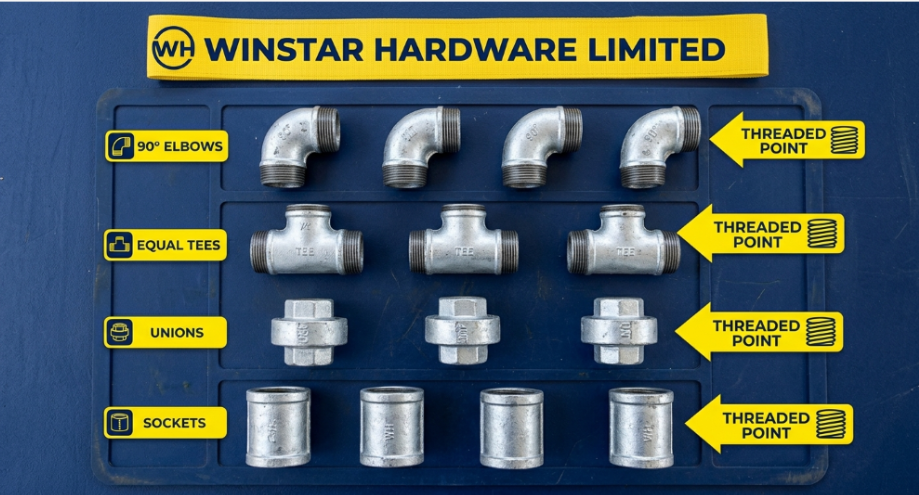
- Ninety-degree and forty-five-degree elbows allow plumbers to route pipelines cleanly around building corners.
- Equal and reducing tees split a single water supply line into two separate directional branches.
- Meanwhile, straight sockets join two pipes of identical diameter to extend long horizontal or vertical runs.
- Reducing sockets and bushes connect larger main pipes smoothly to smaller branch lines.
- Indeed, stocking the right directional connectors from a GI Pipes and Fittings Guide eliminates awkward pipe bending on site.
For an up-close look at different connector types and male-female thread alignment, you can review this detailed tutorial on galvanized fittings and pipe applications.
#8. Unions, Nipples, and Reducers for Maintenance and Transitions
- Pipe unions feature a three-piece nut design that lets plumbers disconnect lines without cutting steel.
- Therefore, technicians always install unions near water pumps, rooftop tanks, and booster valves for easy servicing.
- Barrel nipples and hex nipples provide short, externally threaded bridges between two female fittings.
- Specifically, hex nipples include a central nut section that accepts standard adjustable wrenches for tight grip.
#9. Gate Valves, Check Valves, and End Caps
- Brass or cast-iron gate valves give property owners full manual control to isolate water sections during repairs.
- Similarly, non-return check valves prevent pumped water from flowing backward into boreholes or underground tanks.
- End caps and threaded plugs seal off unused pipe terminations to block dirt and prevent leaks.
- Furthermore, consulting a GI Pipes and Fittings Guide ensures buyers pick full-bore valves that maintain strong water pressure.
How to Spot Quality Plumbing Hardware in Kenya
Substandard steel pipes and poorly cast fittings frequently enter the local market at deceptively low prices. However, weak walls and thin zinc coatings rust rapidly, leading to burst pipes inside concrete walls. Consequently, buyers must inspect every batch carefully before leaving the hardware yard.
#10. Checking for KEBS Certification and Mill Markings
- Authentic pipes bear clear, indelible ink stamps showing the manufacturer name, pipe class, and size.
- Additionally, look for the official Kenya Bureau of Standards (KEBS) standardization mark along the pipe barrel.
- Reputable suppliers like Winstar Hardware Limited stock only certified materials that meet strict national safety benchmarks.
- Conversely, unmarked pipes often lack proper pressure testing and fail prematurely under normal municipal water surges.
#11. Inspecting Zinc Coating Uniformity and Thread Precision
- Examine both the exterior surface and the inside bore for a smooth, continuous silvery-gray zinc finish.
- Reject any lengths showing dark bare-steel patches, rough lumps, or flaking metallic scales.
- Moreover, check that factory-cut threads look sharp, clean, and free from broken metal ridges.
- Test-fit a matching elbow onto the pipe thread by hand to verify smooth, wobble-free engagement.
- Notably, every reputable GI Pipes and Fittings Guide stresses thread inspection to prevent stubborn joint leaks.
Quick Checklist from Our GI Pipes and Fittings Guide for In-Store Inspection
- Spin a fitting onto the pipe end; it should turn smoothly for three to four rotations before tightening.
- Sight down the length of the pipe to confirm it sits completely straight without transport bends.
#12. Avoiding Counterfeit and Under-Gauge Pipes
- Unscrupulous dealers sometimes sell thin Class A pipes painted with blue bands to mimic pricier Class B stock.
- Therefore, lift the pipe to feel its heft, as genuine medium and heavy classes carry noticeable weight.
- You can also use a simple vernier caliper to verify actual wall thickness against standard specifications.
- Furthermore, following a GI Pipes and Fittings Guide empowers buyers to spot fake color bands immediately.
Budgeting and Sourcing Tips for Kenyan Buyers
Smart procurement balances upfront material costs with long-term reliability and delivery convenience. Because steel prices fluctuate regularly, planning your bill of quantities early protects your construction budget. Moreover, partnering with an established hardware distributor simplifies bulk logistics across Kenya.
#13. Factors Influencing GI Pipe Prices in Nairobi and Upcountry
- Global raw steel costs and local currency exchange rates directly impact monthly hardware retail prices.
- Additionally, heavier wall grades like Class C cost significantly more per length than lighter Class A pipes.
- Transporting bulky six-meter steel lengths from Nairobi Industrial Area to upcountry towns also adds freight charges.
- Consequently, ordering all required pipes and fittings in one consolidated trip reduces delivery expenses.
#14. Buying Wholesale vs. Retail from Trusted Hardware Suppliers
- Purchasing full bundles for major construction projects unlocks substantial wholesale discounts from major distributors.
- For smaller home repairs, buying individual lengths and loose fittings from reputable retailers avoids material wastage.
- For instance, Winstar Hardware Limited provides competitive pricing and reliable stock for both bulk contractors and walk-in homeowners.
- Likewise, keeping a GI Pipes and Fittings Guide handy helps you compare itemized quotes accurately across different vendors.
How This GI Pipes and Fittings Guide Helps You Negotiate Hardware Quotes
- Always request itemized quotations that explicitly state pipe diameter, class, brand, and unit price.
- Compare total bundle costs rather than focusing solely on single-fitting discounts.
Installation Best Practices and Maintenance
Even the highest-grade steel hardware will leak if plumbers use poor assembly techniques on site. Therefore, proper thread sealing and corrosion protection are essential during final installation. Applying proven plumbing practices guarantees a trouble-free water system for decades.
Proper Sealing Techniques Using Thread Tape and Hemp
- Clean all metal shavings and oil residue from male and female threads before applying sealant.
- Wrap high-density PTFE thread seal tape clockwise around the male threads at least six to eight times.
- Alternatively, experienced Kenyan plumbers combine plumber’s hemp with jointing paste for larger two-inch industrial lines.
- Tighten joints firmly with a pipe wrench, but avoid over-torquing, which can crack cast fittings.
If you ever encounter unexpected joint seepage during system testing, following professional leaky pipe repair DIY step-by-step instructions will help you quickly fix threaded connections without panic.
Preventing Galvanic Corrosion When Mixing Metals
- Connecting galvanized iron directly to copper pipes triggers an electrochemical reaction that rapidly eats away the zinc.
- Instead, install brass valves or specialized dielectric unions to separate dissimilar metals safely.
- Furthermore, wrap underground GI pipes with bitumen tape or anti-corrosion sleeve before backfilling soil trenches.
- Finally, apply a fresh coat of zinc-rich cold galvanizing paint over any exposed wrench marks or cut threads.
Final Takeaways from Our GI Pipes and Fittings Guide
- Read our GI Pipes and Fittings Guide for 14 practical tips on choosing quality sizes, prices, and durable plumbing hardware in Kenya.
- Always hire a licensed plumber and source certified KEBS-approved materials to protect your property investment.