


Burst water lines and leaking drainage pipes ruin expensive Kenyan construction projects every single day. Learning how to choose high-quality PPR and PVC pipes protects your property from costly structural repairs and water wastage. Therefore, sourcing certified plumbing materials from a trusted supplier ensures decades of trouble-free performance.
Understanding the Basics: How to Choose High-Quality PPR and PVC Pipes in Kenya
Plumbing systems rely on distinct piping materials designed for specific water pressures and temperatures. Knowing how to choose high-quality PPR and PVC pipes begins with matching the right polymer to your building’s plumbing layout. Consequently, contractors and homeowners prevent premature joint failures and pipe bursts.
When planning structural expansions or room additions, review the Plumbing for Home Addition: Essential Guide to Planning and Installation to align your pipe routing with local county standards.
#1. Match the Pipe Material to Your Plumbing Application
- Understand material chemistry: Polypropylene Random Copolymer (PPR) handles high heat and pressure, whereas Polyvinyl Chloride (PVC) excels in gravity drainage and cold-water transport.
- Evaluate installation environments: Moreover, internal concealed walls require heat-fused PPR joints, while underground trenches demand rigid PVC conduits.
- Assess long-term durability: Both materials resist rust and scale buildup far better than traditional galvanized iron pipes.
When to Use PPR Pipes (Hot & Cold Pressurized Water)
- Hot water supply lines: Install PPR pipes for solar water heaters, instant showers, and boiler connections because they withstand temperatures up to 95°C.
- Pressurized apartment risers: Furthermore, multi-story buildings in Nairobi and Mombasa rely on PPR to handle high booster pump pressures without bursting.
- Concealed wall plumbing: Heat-fusion welding melts the pipe and fitting into one continuous piece, eliminating hidden leaks behind expensive bathroom tiles.
When to Use PVC Pipes (Drainage, Sewer, and Cold Supply)
- Soil and waste drainage: Use heavy-duty PVC pipes for toilet waste stacks, kitchen sink drains, and bathroom greywater disposal.
- Rainwater harvesting systems: Additionally, UV-stabilized PVC gutters and downpipes efficiently channel rooftop runoff into underground storage tanks.
- Underground cold-water mains: High-pressure PVC pipes safely transport cold municipal or borehole water across long distances on residential plots.
#2. Verify KEBS Certification and International ISO Standards
- Inspect the KEBS Diamond Mark: Always confirm the official Kenya Bureau of Standards (KEBS) certification mark printed clearly along the pipe barrel.
- Check ISO manufacturing codes: Specifically, genuine PPR pipes must display ISO 15874, while authentic pressure PVC pipes must carry ISO 1452 or KS ISO 4422 markings.
- Verify batch traceability: Reliable manufacturers print production dates, shift codes, and raw material grades directly on every meter of pipe.
- Avoid unbranded imports: Unmarked pipes often fail under Kenyan water pressure fluctuations and void building inspection approvals.
Key Technical Specs for How to Choose High-Quality PPR and PVC Pipes
Technical specifications determine whether a plumbing network survives extreme pressure surges or collapses under soil weight. Mastering how to choose high-quality PPR and PVC pipes requires reading pressure ratings and wall thickness gauges accurately. As a result, you avoid overpaying for unnecessary heavy specs or buying dangerously thin pipes.
#3. Decode Pressure Ratings (PN16 vs. PN20 for PPR)
- Understand Nominal Pressure (PN): The PN rating indicates the maximum continuous water pressure in bars that a pipe supports at 20°C.
- Compare wall thickness: Higher PN ratings feature thicker pipe walls, which directly increases thermal resistance and burst strength.
- Account for pump surges: Kenyan water systems frequently experience airlocks and pump spikes, making higher PN ratings a smart safeguard.
Choosing PN20 for Hot Water and High-Rise Buildings in Nairobi
- Mandatory for hot water lines: Always select PN20 pipes for solar water heating loops because high temperatures reduce plastic pressure tolerance.
- Ideal for tall apartments: Similarly, buildings exceeding three floors require PN20 risers to withstand heavy hydrostatic water column pressure.
- Superior mechanical protection: Thick PN20 walls resist accidental punctures during masonry chasing and plastering work.
Choosing PN16 for Standard Cold Water Distribution
- Cost-effective for bungalows: Single-story residential homes running on gravity tank pressure perform reliably with PN16 PPR pipes.
- Suitable for cold internal feeds: Use PN16 for cold-water branches feeding toilets, laundry machines, and outdoor garden taps.
- Ensure proper pressure testing: Nevertheless, plumbers must still hydro-test PN16 lines at 1.5 times working pressure before closing walls.
#4. Inspect Wall Thickness and Class Ratings (Class B, C, D, and E for PVC)
- Match PVC classes to pressure: Class B (6 bar) suits low-pressure irrigation, while Class C (9 bar) and Class D (12 bar) handle pressurized mainlines.
- Select Class E for extreme loads: Use Class E (15 bar) PVC pipes for deep borehole risers and heavy-duty municipal water supply lines.
- Measure wall uniformity: Inspect the cut ends of every PVC pipe to verify even concentric wall thickness without thin spots.
- Check socket depth: Deep, precision-molded bell sockets guarantee strong solvent-cement bonds that never pull apart under pressure.
Top PPR Pipe Brands Stocked at Winstar for Kenyan Projects
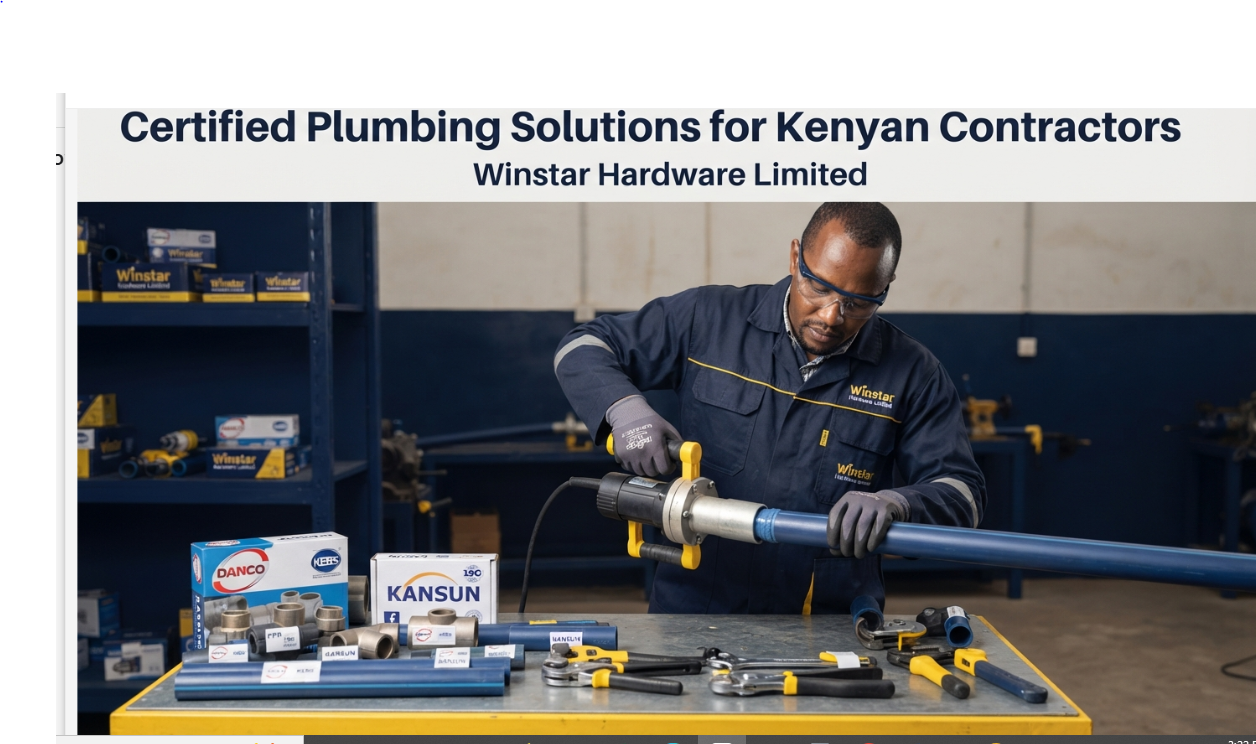
Selecting a proven manufacturer eliminates guesswork regarding virgin raw material purity and dimensional accuracy. Contractors exploring how to choose high-quality PPR and PVC pipes consistently trust established brands stocked at Winstar Hardware Limited. Consequently, your plumber gets uniform pipe diameters that melt smoothly into matching fittings.
#5. Danco PPR Pipes: Heavy-Duty Reliability for Commercial & Residential Builds
- 100% virgin raw materials: Danco manufactures pipes using pure polypropylene granules, ensuring zero toxic leaching into drinking water.
- Superior thermal stability: Moreover, Danco PPR pipes maintain structural rigidity under continuous high-temperature solar heater operation.
- Consistent fusion timing: Plumbers appreciate Danco’s predictable melting behavior, which prevents internal flow blockages during heat welding.
- Full local availability: Danco produces a complete ecosystem of valves, unions, and elbows readily available across Kenya.
#6. Kansun PPR Pipes: How to Choose High-Quality PPR and PVC Pipes on a Budget
- Competitive project pricing: Kansun delivers certified KEBS-approved durability at price points tailored for large-scale Kenyan housing estates.
- Reliable pressure endurance: Despite its budget-friendly cost, Kansun maintains strict PN16 and PN20 wall thickness tolerances.
- Smooth bore finish: Additionally, its low-friction inner wall maximizes water flow rates even when gravity tank levels drop low.
- Wide diameter range: Developers can source everything from 20mm domestic lines to 110mm main distribution headers in one brand.
#7. SeaGreat & Sonado PPR Pipes: Engineered for Longevity and Smooth Flow
- Anti-scaling interior walls: Both SeaGreat and Sonado resist mineral deposits from hard borehole water common in Nairobi, Nakuru, and Machakos.
- High impact toughness: Furthermore, these pipes withstand rough handling on busy construction sites without developing hairline stress fractures.
- Acoustic insulation: Thick polymer walls dampen water hammer noise, keeping apartment bedrooms quiet at night.
- UV-stabilized options: Green and grey UV-resistant outer layers protect exposed rooftop solar connections from harsh equatorial sunlight.
Other Trusted PPR Brands Available at Winstar
- Complimentary specialty lines: Winstar stocks additional KEBS-certified PPR brands to accommodate specific architectural Bills of Quantities (BOQs).
- Specialized brass-insert fittings: Builders can easily source heavy-duty threaded male and female adapters for shower mixers and gate valves.
- Complete size compatibility: Every stocked brand adheres strictly to metric outer diameter standards for seamless system integration.
Leading PVC Pipe Brands at Winstar: Tatu, Doer, and More
Drainage and underground supply lines face crushing soil loads, tree roots, and corrosive wastewater chemicals. Understanding how to choose high-quality PPR and PVC pipes means prioritizing rigid, impact-tested PVC brands. Therefore, Winstar stocks industry-leading PVC pipes engineered specifically for East African ground conditions.
#8. Tatu PVC Pipes: The Gold Standard for Kenyan Drainage and Borehole Casings
- Unmatched structural rigidity: Tatu PVC pipes resist soil deformation under driveways, parking lots, and deep foundation trenches.
- Precision rubber-ring joints: Their heavy-duty sewer pipes feature integrated EPDM rubber seals that absorb ground movement without leaking.
- Certified borehole casings: Additionally, Tatu manufactures slotted and plain thick-walled casings trusted by Kenyan water drilling contractors.
- UV-resistant formulation: Exposed exterior waste stacks resist chalking, brittleness, and sun damage for over three decades.
#9. Doer PVC Pipes: High-Performance Solutions for Modern Plumbing
- High chemical resistance: Doer PVC pipes safely transport aggressive household detergents, septic effluents, and industrial wastewater.
- Leak-free solvent welding: Smooth, calibrated pipe ends create airtight molecular bonds when paired with quality PVC solvent cement.
- Lightweight handling: Furthermore, Doer pipes reduce labor fatigue and transport costs while maintaining exceptional ring stiffness.
- Consistent availability: Contractors find uniform stock across standard 32mm, 40mm, 50mm, 110mm, and 160mm drainage sizes.
Comparing Other Reliable PVC Brands at Winstar
- Agricultural irrigation solutions: Winstar carries specialized high-pressure PVC lines engineered for drip irrigation and farm water distribution.
- Electrical and telecom conduits: Builders can simultaneously procure heavy-gauge PVC electrical conduits during a single hardware run.
- Strict quality vetting: Every PVC brand on Winstar shelves undergoes verification for dimensional accuracy and KEBS compliance.
Physical Inspection Checklist: How to Choose High-Quality PPR and PVC Pipes on Site
Even reputable brand labels require physical verification before you load pipes onto your site delivery truck. Mastering how to choose high-quality PPR and PVC pipes empowers you to spot manufacturing defects instantly. As a result, you reject substandard batches before they ever enter your trenches or walls.
#10. Check Surface Finish, Color Consistency, and Odor
- Inspect surface smoothness: Run your hand along the pipe exterior and interior to confirm a glossy, glass-smooth finish free of ripples.
- Verify uniform coloration: High-grade pipes display solid, consistent coloring without pale streaks, dark patches, or translucent thin spots.
- Check for neutral odor: Pure virgin polypropylene and PVC smell completely neutral, whereas recycled scrap emits harsh chemical odors.
How to Choose High-Quality PPR and PVC Pipes by Spotting Recycled Plastic
- Look for black specks: Tiny dark dots embedded in the pipe wall indicate contaminated, reground plastic waste.
- Avoid chalky textures: Dull, powdery surfaces signify excessive calcium carbonate filler added to cut manufacturing costs cheaply.
- Reject brittle edges: Recycled pipes chip and splinter easily when cut with a standard ratcheting pipe cutter.
Testing Flexibility and Impact Resistance Before Purchase
- Perform the squeeze test: Press the open end of a PVC pipe firmly; quality pipes flex slightly and spring back without whitening.
- Check cut cleanlines: Genuine PPR slices smoothly like hard wax, producing a clean curl of plastic rather than jagged crumbs.
- Inspect for ovality: Ensure pipe ends form a true circle rather than a flattened oval caused by improper warehouse stacking.
#11. Verify Clear Print Markings and Batch Numbers
- Test ink adhesion: Rub the printed specification line firmly with your thumb; authentic factory laser or ink markings never smudge off.
- Confirm dimensional details: Check that the printed outer diameter and wall thickness (e.g., 25mm x 4.2mm for PN20) match physical measurements.
- Verify manufacturing date: Fresh stock ensures maximum polymer elasticity and prevents shelf-aged brittleness.
Brand Comparison Matrix: PPR vs. PVC Options at Winstar
Comparing technical strengths side by side simplifies procurement decisions for busy contractors and self-builders. Reviewing how to choose high-quality PPR and PVC pipes across stocked brands helps balance your budget against project requirements. Consequently, you allocate heavy-duty specs where they matter most.
Side-by-Side Breakdown of Winstar’s Top Plumbing Brands
- Evaluate application fit: Match each brand’s core engineering strength directly to your building’s water supply or drainage zone.
- Compare price-to-performance ratios: Balance upfront material costs against long-term warranty protection and structural load demands.
How to Choose High-Quality PPR and PVC Pipes by Brand and Application
| Brand Name | Pipe Type | Primary Application | Pressure / Class Rating | Key Advantage |
| Danco | PPR | Hot & cold pressurized supply | PN16 / PN20 | Superior thermal endurance & fusion consistency |
| Kansun | PPR | Residential & estate water supply | PN16 / PN20 | Cost-effective durability for bulk housing projects |
| SeaGreat | PPR | High-rise risers & solar loops | PN20 | Anti-scaling interior & high impact toughness |
| Sonado | PPR | Domestic & commercial plumbing | PN16 / PN20 | Smooth bore flow & UV-stabilized exterior |
| Tatu | PVC | Heavy drainage, sewer & boreholes | Class B, C, D, E / Heavy | Gold-standard soil load & UV resistance |
| Doer | PVC | Waste, soil & cold-water lines | Standard & Pressure | High chemical resistance & tight solvent joints |
Matching Fittings and Valves to Avoid Joint Failures
- Stick to single-brand systems: Always pair Danco pipes with Danco elbows and tees because slight thermal expansion differences between brands weaken welds.
- Inspect brass inserts: Check that PPR threaded adapters feature deep, knurled brass rings molded tightly into the plastic body.
- Use fresh solvent cement: For PVC installations, apply thick, unexpired PVC glue evenly to both pipe spigot and fitting socket.
Avoiding Counterfeits and Common Buying Mistakes in Kenya
Counterfeit plumbing materials flood informal hardware markets across Nairobi, Kisumu, and Mombasa every year. Knowing how to choose high-quality PPR and PVC pipes protects your investment from fake branding and dangerous shortcuts. Therefore, smart buyers look beyond the cheapest per-meter sticker price.
#12. How to Choose High-Quality PPR and PVC Pipes Without Falling for Fakes
- Beware suspiciously low prices: If a pipe costs 30% below standard market rates, it likely contains recycled plastic or counterfeit KEBS stamps.
- Inspect spelling on pipe barrels: Counterfeiters frequently misspell brand names, ISO codes, or technical terms along the print line.
- Buy from authorized stockists: Purchasing directly from reputable distributors like Winstar Hardware Limited guarantees authentic factory-sealed stock.
- Check fitting weight: Genuine PPR and PVC fittings feel noticeably heavier and denser than thin-walled counterfeit imitations.
Calculating Total Project Cost vs. Upfront Pipe Price
- Factor in demolition expenses: Replacing one burst concealed PPR pipe requires breaking imported ceramic tiles, chiseling concrete, and re-plastering walls.
- Protect interior finishes: Water leaks destroy gypsum ceilings, wooden wardrobes, and electrical conduits within hours.
- Invest upfront for 50-year lifespan: Spending slightly more on certified Danco, Kansun, or Tatu pipes saves hundreds of thousands of shillings in repairs.
Why Source Your PPR and PVC Pipes from Winstar?
Partnering with an established plumbing distributor streamlines procurement from foundation excavation to final bathroom fitting. Applying everything you know about how to choose high-quality PPR and PVC pipes becomes effortless when every brand on the shelf meets strict standards. Ultimately, Winstar Hardware Limited delivers reliability, technical guidance, and unmatched product variety under one roof.
Direct Manufacturer Sourcing and Guaranteed Authenticity
- Zero counterfeit risk: Winstar sources directly from authorized manufacturers for Danco, Kansun, SeaGreat, Sonado, Tatu, and Doer.
- Proper warehouse storage: Pipes remain stored flat on shaded racks, preventing sun-induced warping and oval deformation before purchase.
- Complete accessory availability: Contractors find matching fusion machines, pipe cutters, thread seal tapes, and brass valves in one visit.
To explore a complete inventory of certified valves, drainage channels, and accessories, browse the Flowing Solutions for Nairobi and Beyond: 11 Essential Plumbing Hardware Must-Haves.
How to Choose High-Quality PPR and PVC Pipes with Winstar’s Expert Support
- Professional BOQ quotation: Share your architectural plumbing schedule with our technical team for accurate, itemized material estimates.
- Competitive wholesale rates: Enjoy tiered bulk discounts tailored for building contractors, real estate developers, and individual homeowners.
- Reliable countrywide delivery: We coordinate prompt dispatch to construction sites across Nairobi and major Kenyan towns.
Learn how to choose high-quality PPR and PVC pipes in Kenya. Compare top brands like Danco, Kansun, Tatu & Doer at Winstar today. Visit our showroom or contact our sales team now for a fast, competitive quote on your upcoming plumbing project!