


The construction landscape across Kenya’s Rift Valley and Central regions is undergoing an unprecedented boom. From expanding urban commercial hubs in Nakuru and Eldoret to residential housing projects in Nyeri, Thika, Naivasha, and Kiambu, developers are actively pushing the boundaries of modern infrastructure. However, with rapid growth comes a critical challenge: ensuring structural longevity and system reliability.
In fact, the plumbing infrastructure forms the circulatory system of any building. Consequently, when contractors compromise on piping and fittings, the consequences are immediate and severe—wall disfigurement from dampness, water contamination, slab destruction, and frequent maintenance overhauls. Navigating regional distribution channels to acquire genuine, high-grade piping systems and water handling accessories is paramount.
Sourcing quality plumbing materials from Rift to Central requires a keen understanding of local geological conditions, certified manufacturing standards, and direct distributor networks. As a leading supplier across these regional corridors, Winstar Hardware Limited provides local builders with direct access to certified piping systems, heavy-duty drainage, and precision valves tailored to high-altitude and varied ground environments. By sourcing through established distribution channels, contractors can guarantee structural resilience from foundation laying to final interior finishing.
Key Factors to Consider When Sourcing Plumbing Materials
Environmental and Water Quality Considerations Across Rift and Central
The geographical contrast between the Rift Valley and the Central highlands creates distinct environmental challenges for plumbing installations.
Fluoride and Hard Water Management in Rift Valley Topography
The Rift Valley region—spanning Nakuru, Naivasha, and Baringo—is renowned for high fluoride concentrations and mineral-heavy hard water derived from volcanic soils. Standard metallic pipes used in these areas experience rapid mineral scaling, calcification, and internal pitting corrosion. Over time, internal pipe diameters shrink, reducing flow rates and causing joint failures.
To combat scaling, contractors in the Rift region prioritize non-metallic materials such as Polypropylene Random Copolymer (PPR) and High-Density Polyethylene (HDPE), which possess smooth inner surfaces that resist scale build-up and chemical degradation.
Acidic Soil and Variable Moisture Conditions in Central Kenya
Conversely, parts of Central Kenya—including high-altitude zones around Mt. Kenya, Nyeri, and Murang’a—feature organic-rich, acidic red soils and high seasonal rainfall. Underground piping laid in these soils faces constant exposure to moisture and soil acidity, which rapidly degrades poor-quality metallic conduits or unjacketed low-grade plastics. Underground water distribution in these environments requires corrosion-proof HDPE or thick-walled uPVC conduits engineered to withstand external soil friction, ground settling, and chemical reactivity.
Standards and Compliance: Identifying Certified Quality Plumbing Materials from Rift to Central
Ensuring that every pipe, joint, and valve meets stringent manufacturing benchmarks protects your project against dangerous leaks and structural failures.
Navigating KEBS Certifications and Diamond Marks of Quality
Before purchasing any plumbing inventory, builders must verify that materials carry the official Kenya Bureau of Standards (KEBS) Diamond Mark of Quality. KEBS-certified pipes undergo rigorous pressure testing, thermal endurance evaluation, and toxicological screening to ensure they are safe for potable water supply.
Certified products display indelible batch numbers, pressure ratings (PN ratings), and manufacturer details printed clearly along the length of the pipe at regular intervals.
Detecting Counterfeit and Non-Standard Imports
The Kenyan construction market is occasionally flooded with substandard imports that copy popular branding but lack structural integrity. Substandard PPR pipes often feature uneven wall thicknesses, making them prone to bursting during thermal fusion welding. Low-grade PVC pipes frequently substitute raw resin with excessive calcium carbonate filler, rendering the pipes brittle and susceptible to cracking under minimal impact.
Working with established supply partners like Winstar Hardware Limited guarantees that contractors receive genuine, factory-tested products accompanied by official manufacturer warranties and compliance certificates.
Core Product Portfolio: Top Quality Plumbing Materials from Rift to Central Hardware Stores
A robust plumbing installation relies on selecting the exact material grade for each specific water or waste management application within a building project.
PPR and HDPE Piping Systems for Hot, Cold, and Underground Supplies
Modern water distribution relies heavily on advanced thermoplastics due to their exceptional longevity, hygiene, and resistance to environmental stress.
High-Performance PPR Pipes for Indoor Hot and Cold Water Lines
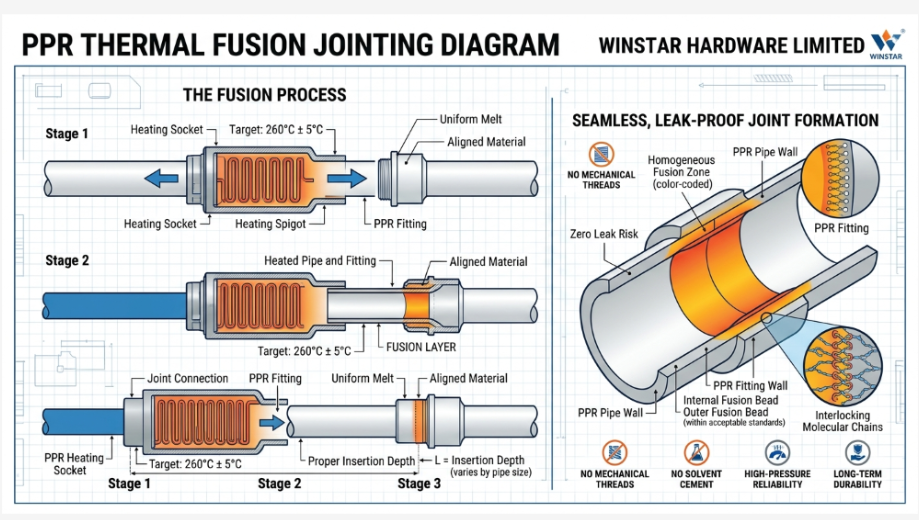
PPR (Polypropylene Random Copolymer Type 3) has become the gold standard for indoor plumbing across Kenya. PPR pipes are joined using thermal socket fusion, creating a continuous, leak-proof homogenous plastic system where the joint is as strong as the pipe itself.
- PN10 & PN16 Ratings: Ideal for cold water distribution and low-pressure plumbing installations.
- PN20 & PN25 Ratings: Specifically engineered for hot water lines, solar water heater connections, and high-pressure riser systems.
- Thermal Insulation Properties: PPR exhibits low thermal conductivity, preventing heat loss in hot water runs and eliminating external condensation (sweating) on cold water
- To ensure long-term pressure integrity without joint degradation, contractors should follow proper thermal jointing procedures demonstrated in this PPR Pipe Fusion Welding Tutorial when working with hot and cold water installations.
Heavy-Duty HDPE Pipes for Main Supply Lines and Agricultural Irrigation
High-Density Polyethylene (HDPE) is unmatched for external water mains, municipal tie-ins, boreholes, and agricultural irrigation networks across Rift Valley farms and Central agricultural schemes.
- Flexibility & Impact Resistance: HDPE can absorb ground movement, soil shifting, and traffic vibrations without cracking.
- Coil Convenience: Available in long continuous coils (up to 100 meters), minimizing the need for intermediate joints in long-distance pipe runs.
- Pressure Handling: Rated from PN6 up to PN20, making HDPE suitable for deep borehole submersibles and high-head pumping stations.
When laying long-distance supply lines across varied soil topographies, learning how to assemble mechanical compression fittings properly—as shown in this step-by-step HDPE Pipe Jointing Tutorial—prevents underground leakage and structural head losses.
Premium PVC and uPVC Solutions for Soil, Waste, and Rainwater Drainage
Managing wastewater, sewage, and storm runoff requires durable, smooth-bore piping that resists chemical attack and physical impacts.
Heavy-Duty uPVC Soil and Waste Pipes (BS 4514 / EN 1329)
Unplasticized Polyvinyl Chloride (uPVC) is rigid, lightweight, and specifically formulated for indoor vertical stacks, soil waste lines, and underground drainage channels.
- Golden Brown uPVC: Designed for underground drainage systems, featuring heavy wall construction to withstand backfill pressure and soil compaction.
- Grey uPVC: Formulated for above-ground indoor soil, waste, and vent (SWV) systems, providing high resistance to household chemicals, hot discharge water, and detergents.
UV-Resistant Rainwater Gutter Systems
Given the heavy seasonal rainfall experienced in Central Kenya and the high-altitude conditions of the Rift Valley, rainwater harvesting systems require UV-stabilized uPVC gutters and downspouts. These components resist color bleaching, thermal warping, and cracking caused by prolonged exposure to intense high-altitude sunlight.
High-Grade Valves, Brass Fittings, and Fixtures for Long-Term Reliability
Even the most durable piping network will fail if terminal controls, shut-off valves, and structural connectors are low quality.
Heavy-Duty Gate Valves and Check Valves
Flow control fixtures regulate system pressure and isolate plumbing sections during maintenance.
- Full-Port Brass Gate Valves: Manufactured from solid, corrosion-resistant brass to prevent internal binding, ensuring smooth operation even in hard water environments.
- Non-Return Check Valves: Protect pumps and pressure vessels from dangerous water hammer effects by ensuring unidirectional flow.
Precision Compression Fittings and Transition Adaptors
Connecting plastic piping (PPR or HDPE) to metallic fixtures or existing infrastructure requires high-precision brass threaded adaptors (male and female BSP threads). High-quality transition fittings incorporate deep knurling and robust EPDM O-rings to maintain airtight and watertight seals under high temperature and pressure fluctuations.
Purchasing Guide: Where and How to Order Quality Plumbing Materials from Rift to Central Region Outlets
Efficient material procurement keeps construction projects on schedule and prevents budget overruns caused by material shortages or transport delays.
Major Regional Supply Hubs: Directing You to Trusted Distributors in Nakuru, Eldoret, and Nyeri
Sourcing plumbing hardware locally reduces downtime, lowers shipping costs, and provides immediate access to technical assistance.
Navigating Commercial Procurement in the Rift Valley
Nakuru and Eldoret serve as the primary supply arteries for the entire Western and Rift regions.
- Nakuru Central Business District & Industrial Area: The major destination for sourcing large-diameter HDPE lines, borehole casings, and commercial drainage stacks.
- Eldoret Hardware Corridors: Ideal for contractors servicing Uasin Gishu, Nandi, and Trans-Nzoia, offering broad inventories of irrigation equipment, PPR systems, and sanitary fixtures.
Streamlined Hardware Sourcing Across Central Kenya
Nyeri, Thika, and Kiambu represent the commercial powerhouse of Central Kenya, supplying structural projects along the Mt. Kenya circuit.
- Thika & Kiambu Outlets: Serve as rapid-response procurement zones for high-density residential developments surrounding the Nairobi Metropolitan Area.
- Nyeri Procurement Hubs: Provide localized distribution for commercial, hospitality, and institutional developments across Laikipia, Kirinyaga, and Nyeri counties.
Streamlined Logistics and Delivery Channels Connecting the Two Regions
Modern construction timelines depend on reliable logistics that bridge the regional gap between Rift Valley and Central hardware warehouses.
Consolidating Hardware Orders for Remote Construction Sites
Contractors working on rural or off-grid sites across Nakuru, Baringo, or Nyandarua often face logistical challenges when sourcing specialized fittings. Partnering with full-service hardware distributors—such as Winstar Hardware Limited—allows builders to consolidate their entire order (from pipes and solvent cements to heavy valves and sanitaryware) into a single, coordinated delivery truck, eliminating multiple freight fees and dispatch delays.
Requesting Quotations, Site Estimates, and Bulk Trade Credit
For commercial developments and large housing estates:
- Submit Bills of Quantities (BQ): Send complete plumbing schedules to regional sales desks for transparent line-item pricing and volume discounts.
- Request On-Site Batching: Arrange staggered deliveries aligned with your project phases (e.g., Phase 1: Underground Drainage; Phase 2: First-Fix Wall Chasing; Phase 3: Final Fixture Trim).
- Verify Return Policies: Ensure your distributor offers straightforward return or exchange terms for unused standard pipe lengths and excess fittings.
Cost Breakdown and Budgeting Tips for Large-Scale Construction Projects
Accurate financial planning prevents mid-project stalls and ensures your building meets structural standards without breaking the bank.
Estimating Material Costs for Residential and Commercial Developments
Plumbing material costs vary based on pipe dimensions, pressure ratings, and connection technologies.
Average Price Ranges for Standard Piping Categories (KSh)
While prices fluctuate based on raw resin costs and market dynamics, the following benchmarks help project managers formulate realistic BQs across Rift and Central:
- PPR Pipes (20mm – 32mm, PN20): Typically range from KSh 350 to KSh 900 per 4-meter length, depending on wall thickness and brand certification.
- HDPE Pipes (32mm – 63mm, PN10/PN16): Range from KSh 120 to KSh 450 per linear meter when purchased in continuous rolls.
- uPVC Waste & Soil Pipes (4-inch / 110mm): Standard 3-meter lengths generally range from KSh 1,200 to KSh 2,800 depending on light-duty vs. heavy-duty underground gauge specifications.
Factoring in Wastage Margins and Fitting Ratios
When calculating material quantities, always include a 5% to 8% wastage allowance to account for pipe offcuts, thermal welding margins, and unexpected routing adjustments. Furthermore, budget approximately 35% to 45% of your total piping spend specifically for fittings (elbows, tees, sockets, unions, and adaptors), as high-density connection points represent a significant portion of overall hardware expenditure.
ROI of Investing in Quality Plumbing Materials from Rift to Central Suppliers
Choosing cheaper, unbranded plumbing components may seem like a cost-saving measure during the initial tender phase, but it consistently leads to severe long-term financial losses.
Preventing Costly Structural Repairs and Slab Destruction
A single burst sub-surface pipe inside a concrete slab or hidden within tiled bathroom walls can cost hundreds of thousands of shillings to fix. The repair costs include:
- Demolishing finished masonry and expensive tile work.
- Replacing ruined electrical cabling and waterlogged cabinetry.
- Locating and patching the concealed failure point.
- Re-tiling, re-plastering, and re-painting affected zones.
Investing in KEBS-certified, pressure-tested materials eliminates sub-surface joint failure risks, safeguarding your finished building assets for generations.
Enhancing Property Value and Rental Yields
Commercial tenants and homebuyers across Nakuru, Eldoret, Thika, and Kiambu are increasingly discerning. Buildings with reliable water pressure, silent drainage systems, leak-free fittings, and continuous hot-water PPR networks command higher rental yields and experience significantly lower tenant turnover rates.
Conclusion: Secure Your Construction Investment with Proven Plumbing Solutions
Building structural success in Kenya’s Rift Valley and Central regions demands an uncompromising commitment to material quality. From combating volcanic hard water in Nakuru to resisting acidic soil conditions in Nyeri and Kiambu, selecting the correct pipe gauges, UV-stabilized gutters, and heavy-duty valves directly dictates the longevity of your real estate investment.
By prioritizing certified standards, utilizing specialized PPR and HDPE technologies, and partnering with trusted regional distributors, contractors and developers can ensure seamless water management across every stage of construction. Protect your building’s future today by insisting on genuine, factory-tested plumbing materials engineered for the unique environmental demands of Kenya’s heartland.