


Electricity bills keep climbing across Kenyan households, pushing many property owners toward solar water heating. However, true confidence in understanding hot water solar system hardware begins long before a technician steps onto your roof. Knowing how tanks, collectors, and valves interact prevents costly leaks, early corrosion, and weak shower pressure.
Understanding Hot Water Solar System Hardware in Kenyan Homes
Kenyan towns enjoy abundant sunshine year-round, making solar thermal heating a practical plumbing upgrade. Meanwhile, regional differences in water hardness, roof pitch, and altitude demand tailored hardware choices. Consequently, homeowners who inspect component specifications early avoid premature replacements.
Why Understanding Hot Water Solar System Hardware Matters Before Plumbing
- First, understanding hot water solar system hardware helps you match collector designs with local weather patterns in Nairobi, Mombasa, or Kisumu.
- Furthermore, direct systems circulate household water straight through rooftop collectors, whereas indirect loops isolate closed heat-transfer fluids.
- Additionally, thermosiphon setups rely on natural convection from a roof-mounted tank, while split systems use pumps for ground-level storage.
- Moreover, elevated storage tanks supply steady gravity pressure, whereas low-elevation roofs often require pressurized cylinders.
- Therefore, evaluating your existing household pipe network ensures smooth integration with new solar supply lines.
- Equally important, verified hardware prevents recurring leak repairs and lowers overall household power consumption.
- As a result, buyers gain reliable morning hot water even during overcast July mornings in central Kenya.
- Finally, consulting specialists like Winstar Hardware Limited clarifies local compatibility before you commit to full plumbing installation.
How Solar Thermal Collectors Capture Energy
Solar collectors act as the thermal engine of any rooftop water heating setup. Specifically, they absorb solar radiation and transfer that heat directly into cold water or a closed glycol loop. Choosing between panel and tube designs depends on your local climate and budget.
Flat-Plate vs. Evacuated Tube Collectors in Kenyan Climates

- Initially, flat-plate collectors perform reliably in warm lowland towns such as Mombasa, Malindi, and Garissa.
- Conversely, evacuated tube collectors retain heat better during chilly mornings in Limuru, Nyeri, and Eldoret.
- Besides thermal efficiency, understanding hot water solar system hardware reveals how hail, wind, and maintenance affect each collector style.
- For a deeper look at system sizing and energy savings across Kenyan homes, read our guide on cost-effective water heating solutions in Kenya
Item #1: Absorber Plates & #2: Glazing Covers
- Specifically, dark selective coatings on copper or aluminum absorber plates maximize solar heat capture.
- Meanwhile, copper risers bonded to the absorber plate conduct thermal energy rapidly into circulating water.
- In addition, low-iron tempered glazing covers allow maximum sunlight penetration while shielding internal plates from rain and dust.
- Consequently, durable glazing withstands heavy tropical downpours and accidental impact from falling branches.
- Furthermore, high-density backing insulation inside the collector box minimizes downward heat loss into the roof deck.
Item #3: Vacuum Glass Tubes & #4: Heat Pipe Cores
- Essentially, double-walled borosilicate glass tubes create an insulating vacuum barrier that traps captured solar heat.
- Inside each tube, sealed copper heat pipes vaporize small amounts of liquid to transfer warmth rapidly upward into the manifold.
- Moreover, cylindrical tubes track sunlight efficiently from early morning through late afternoon without mechanical motors.
- Similarly, technicians replace individual damaged glass tubes without draining the entire rooftop storage tank.
- However, plumbers must handle evacuated tubes carefully during rooftop hoisting to prevent accidental breakage.
Storage Tanks, Insulation, and Water Quality Factors
A solar collector cannot deliver value unless your storage cylinder preserves hot water overnight. Meanwhile, borehole and municipal water supplies across Kenya carry varying mineral loads that attack metal surfaces. Thus, internal tank metallurgy and thick insulation determine overall system longevity.
Tank Materials, Linings, and Hard Water Scaling
- Primarily, residential buyers choose between 150-liter, 200-liter, and 300-liter storage capacities based on family size.
- Moreover, understanding hot water solar system hardware prevents premature tank failure in areas with salty or mineral-heavy water.
Item #5: Enamel & Stainless Tanks + #6: Magnesium Anodes
- Typically, inner cylinders use either food-grade SUS 316L stainless steel or vitreous porcelain-enamel coated carbon steel.
- Notably, 316L stainless steel resists chloride pitting in coastal towns and aggressive borehole water supplies.
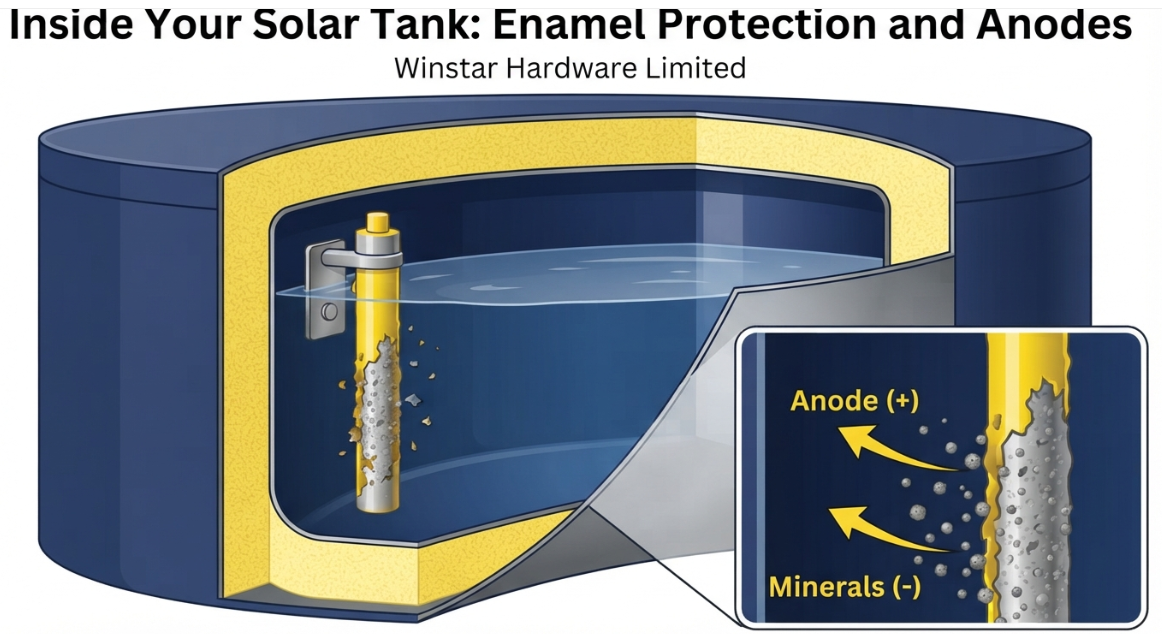
- Furthermore, sacrificial magnesium anode rods attract corrosive minerals away from welded tank seams.
- Therefore, plumbers inspect and replace depleted magnesium rods periodically to extend cylinder service life.
- Additionally, outer tank cladding uses galvanized steel or aluminum-zinc alloy to endure intense equatorial UV exposure.
Item #7: Polyurethane Insulation & #8: Scale Reducers
- Specifically, machine-injected polyurethane foam jackets measuring 50mm to 60mm keep water hot for up to 72 hours.
- As a result, your household enjoys steaming showers early the next morning without activating electric heaters.
- Meanwhile, hard water in areas like Athi River, Naivasha, and Kitengela deposits limescale inside heat exchangers and pipes.
- Consequently, inline magnetic or polyphosphate scale reducers protect narrow collector channels from mineral blockages.
- Likewise, sediment filters at the cold inlet trap sand and rust particles before they enter your solar cylinder.
Plumbing Valves, Pumps, and Pressure Dynamics
Safe solar plumbing requires far more than simple supply and return pipes. Because solar collectors can heat water beyond 80°C on bright afternoons, pressure and temperature controls remain vital. Proper hydraulic components protect both your family and your plumbing fixtures.
Understanding Hot Water Solar System Hardware Controls and Flow
- Fundamentally, pressurized systems operate under mains or booster pump pressure, while non-pressurized tanks rely on gravity.
- Therefore, understanding hot water solar system hardware ensures every valve matches your home’s exact operating pressure rating.
Item #9: T&P Relief Valves & #10: Non-Return Check Valves
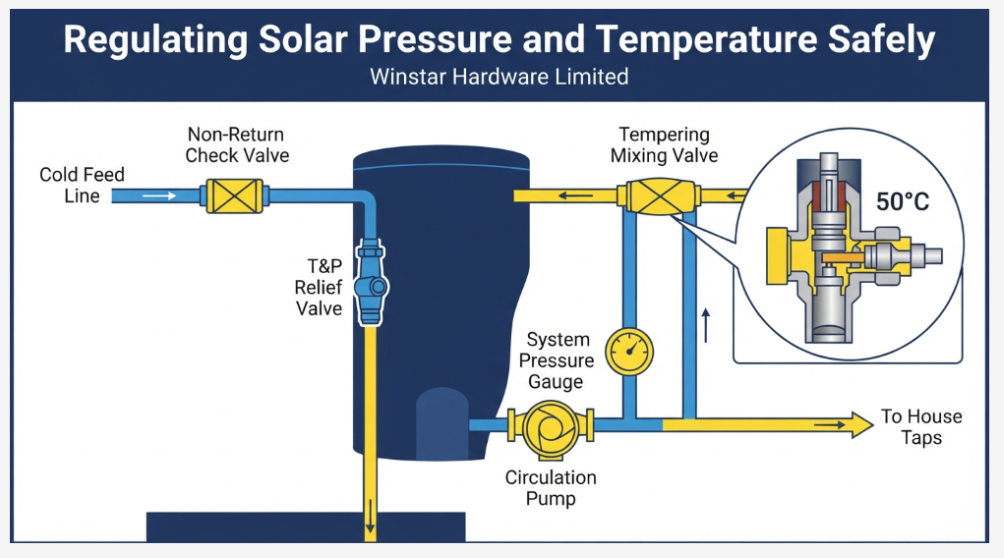
- Crucially, Temperature and Pressure (T&P) relief valves automatically discharge excess steam or pressure if tank limits rise too high.
- Accordingly, plumbers route T&P discharge pipes downward safely toward a roof gutter or exterior drain.
- In addition, non-return check valves stop hot tank water from flowing backward into cold rooftop storage tanks at night.
- Similarly, check valves prevent reverse thermosiphoning, which otherwise cools down your stored water after sunset.
- Moreover, brass isolation ball valves allow technicians to service individual components without shutting off water to the entire house.
- You can also review practical tips on backflow prevention for protecting your drinking water before finalizing your valve layout.
Item #11: Tempering Mixing Valves & #12: Booster Pumps
- Specifically, thermostatic tempering mixing valves blend scalding solar water with cold water to deliver a safe 50°C at taps.
- Thus, children and elderly family members stay protected from sudden thermal burns in the shower.
- Meanwhile, compact circulation pumps move heat-transfer fluid efficiently in split systems where the tank sits below the collectors.
- Furthermore, silent variable-speed booster pumps strengthen weak shower pressure in single-story bungalows with low tank stands.
- Consequently, balanced hydraulic pressure ensures rain showers and mixer taps function smoothly across every bathroom.
Roof Orientation, Tilt Angles, and Structural Load
Even top-tier solar hardware underperforms if mounted at the wrong angle or on weak roof trusses. Because Kenya straddles the equator, solar positioning follows unique seasonal sun paths across the year. Careful structural preparation prevents roof leaks and wind uplift damage.
Roof Orientation, Tilt Angles, and Structural Load
- Initially, roofers check timber rafters or steel trusses before hoisting a full 200-liter or 300-liter system.
- Remember that a filled 300-liter solar unit weighs well over 350 kilograms once water and frames are included.
- Furthermore, understanding hot water solar system hardware clarifies why frame geometry affects daily heat output.
Item #13: North-Facing Alignment & #14: Tilt Brackets
- Generally, properties located south of the equator—including Nairobi, Machakos, and Kajiado—orient collectors facing true north.
- Conversely, homes north of the equator—such as Kisumu, Eldoret, and Nanyuki—tilt collectors slightly south or flat depending on latitude.
- Typically, galvanized steel or anodized aluminum brackets set a tilt angle between 10 and 15 degrees.
- Moreover, this gentle incline encourages natural thermosiphon circulation while allowing rainwater to wash away surface dust.
- Additionally, installers avoid shading from nearby perimeter trees, water towers, and neighboring apartment walls.
Item #15: Roof Truss Load & #16: Wind Anchoring
- Before installation, technicians distribute tank weight across multiple load-bearing trusses rather than resting frames on thin iron sheets.
- Where roofs lack steep pitches, heavy-duty A-frame stands elevate the storage cylinder safely above the collector header.
- Furthermore, stainless-steel lag bolts and EPDM rubber flashings seal every roof penetration against heavy seasonal rains.
- Meanwhile, diagonal wind bracing anchors collectors firmly against strong gusts in open plains and coastal zones.
- Consequently, secure structural mounting protects both your roof waterproofing and your hardware warranty.
Understanding Hot Water Solar System Hardware Connections and Backup
Integrating a solar water heater into an existing Kenyan home requires thoughtful piping and electrical coordination. Even sunny regions experience prolonged cloudy spells during the long rains between March and May. Reliable backup hardware guarantees uninterrupted comfort throughout every season.
Understanding Hot Water Solar System Hardware Connections and Backup
- Primarily, plumbers choose heat-tolerant piping materials that resist warping under sustained high temperatures.
- Moreover, understanding hot water solar system hardware helps you integrate backup heating without spiking monthly power bills.
- Sourcing certified fittings from trusted suppliers such as Winstar Hardware Limited ensures long-term joint integrity across your plumbing lines.
Item #17: Cold Feed Lines & #18: Hot Supply Manifolds
- Specifically, dedicated cold feed lines supply water directly from your elevated overhead tank to the solar cylinder inlet.
- Meanwhile, plumbers use thick-walled PN20 PPR, CPVC, or copper pipes for hot supply lines instead of standard cold-water PVC.
- Standard PVC softens and leaks rapidly when exposed to continuous 70°C solar water.
- Furthermore, central hot supply manifolds distribute balanced water flow to bathrooms, kitchens, and laundry areas simultaneously.
- Additionally, individual isolation valves on manifold branches simplify future tap or shower mixer repairs.
Item #19: Electric Backup Elements & #20: Air Vents
- Typically, a 1.5kW to 3kW stainless-steel immersion heating element sits inside the storage tank for cloudy weather backup.
- Moreover, programmable digital controllers or timers activate this element only during off-peak hours when tank temperatures drop.
- As a result, your household avoids unnecessary grid electricity draw on bright, sunny afternoons.
- Meanwhile, automatic brass air vents installed at the highest piping points release trapped air pockets automatically.
- Consequently, eliminating air locks prevents frustrating dry runs and noisy hammering inside your household pipes.
Routine Servicing and Seasonal Performance Tips
Solar water heaters require minimal upkeep compared to fuel boilers, yet simple preventive care maximizes efficiency. Dust accumulation during dry months and mineral buildup over time gradually reduce heat transfer. Following a basic maintenance routine keeps your system operating at peak output for decades.
Routine Servicing and Seasonal Performance Tips
- Regularly, homeowners schedule light inspections every six to twelve months to catch minor wear early.
- Furthermore, understanding hot water solar system hardware empowers you to spot simple maintenance needs during routine roof checks.
Item #21: Collector Cleaning & #22: Anode Inspections
- Periodically, washing glass collectors early in the morning removes red dust, pollen, and bird droppings that block sunlight.
- Importantly, avoid spraying cold hose water onto scorching glass tubes at midday, as thermal shock can crack hot glass.
- Instead, use a soft sponge and clean water during cool morning hours before collectors heat up.
- Additionally, technicians unscrew and inspect the sacrificial magnesium anode every 18 to 24 months.
- Replacing a worn anode rod early saves you the major expense of replacing a corroded storage tank.
Item #23: Valve Testing & #24: Pipe Lagging Checks
- Twice a year, gently lift the test lever on your T&P relief valve to confirm water discharges freely without mineral jamming.
- Meanwhile, inspect all exterior hot water pipes for cracked or degraded UV-resistant foam insulation lagging.
- Exposed rooftop pipes lose significant heat overnight and allow cool water to reach your morning shower first.
- Therefore, wrapping exterior lagging with protective aluminum tape or UV-stable cladding extends insulation life.
- Finally, verify that digital controller sensors display accurate tank temperatures throughout rainy and dry seasons.
Common Hardware Mistakes and Questions Kenyan Homeowners Ask
Many plumbing headaches stem from cutting corners on small fittings rather than flaws in solar technology itself. Knowing which mistakes to avoid protects your investment from day one. Below is what every Kenyan buyer should weigh before finalizing a system purchase.
Understanding Hot Water Solar System Hardware Costs and Lifespan
- Frequently, buyers install undersized 150-liter tanks for large households, causing cold evening showers.
- Similarly, omitting vacuum breaker valves on non-pressurized tanks can cause thin inner cylinders to collapse during rapid draining.
- Moreover, connecting high-pressure booster pumps to low-pressure gravity tanks often bursts tank seams immediately.
- Consequently, understanding hot water solar system hardware compatibility stops expensive installation errors before water fills the tank.
Item #25: Long-Term Value & System Lifespan Expectations
- Typically, quality flat-plate and evacuated tube systems deliver reliable hot water for 15 to 25 years.
- Meanwhile, most Kenyan households recover their upfront hardware and plumbing investment within three to four years through electricity savings.
- Ultimately, this guide to understanding hot water solar system hardware for Kenyan homes highlights how collectors, tanks, valves, and plumbing basics work together for lasting comfort.
- Whenever you are ready to compare genuine components, visit Winstar Hardware Limited for dependable plumbing guidance tailored to your home.
For a visual walkthrough of how flat-plate solar panels and storage tanks transfer heat in residential setups, watch How does a Flat Panel Solar Water Heater Work. This video illustrates internal collector and tank mechanics clearly for homeowners planning a solar plumbing upgrade.