


Water leaks inside concrete slabs ruin Kenyan homes and drain construction budgets fast. Therefore, choosing premium pipes and fittings for lifetime durability protects your property from costly structural repairs. Furthermore, certified polymer systems withstand harsh local soil conditions and erratic municipal water pressure without corroding.
Why Premium Pipes and Fittings for Lifetime Durability Matter in Kenyan Construction
Plumbing networks sit behind tiled walls and beneath reinforced concrete floors, making future access difficult and expensive. Consequently, smart builders prioritize premium pipes and fittings for lifetime durability during the initial rough-in stage rather than gambling on cheap substitutes. In addition, reliable piping safeguards your building’s resale value and prevents recurring maintenance headaches across decades.
1.1 The Hidden Costs of Substandard Plumbing in Residential and Commercial Builds
- Structural damage: Weak pipe walls crack under pressure, causing dampness that peels paint and weakens concrete slabs.
- Expensive demolition: Contractors must chisel open expensive ceramic tiles and masonry walls to reach burst concealed joints.
- Property devaluation: Visible water stains and mold growth immediately lower rental yields and buyer confidence across Nairobi, Mombasa, and Kisumu.
- Business interruption: Commercial apartments and offices lose tenants when frequent water shutoffs disrupt daily operations.
Slab leaks and early pipe bursts in high-rise apartments
- Vertical pressure loads: Tall residential blocks generate intense static water pressure on lower-floor supply risers.
- Material fatigue: Substandard thin-walled pipes bulge and split after repeated booster pump cycles.
Rising repair labor costs and property devaluation
- Repeated call-out fees: Hiring skilled technicians to trace hidden leaks costs far more than buying certified materials upfront.
- Wasted water bills: Unnoticed underground seepage inflates monthly utility charges and empties overhead storage tanks rapidly.
1.2 How Soil Acidity, Hard Water, and Pressure Fluctuations Impact Kenyan Pipework
- Mineral scaling: Borehole water in many Kenyan counties carries high calcium and magnesium levels that choke metal pipes.
- Zero internal rust: Smooth polymer bores resist mineral buildup and maintain steady water flow over fifty years.
- Surge tolerance: Certified thermoplastics absorb sudden water hammer shocks when county water supply resumes.
- Chemical stability: Inert plastic compounds resist aggressive soil salts without pitting or wall thinning.
Scaling and corrosion caused by borehole hard water
- Galvanized failure: Traditional galvanized iron pipes rust internally within a few years when exposed to hard borehole water.
- Clean water delivery: Choosing premium pipes and fittings for lifetime durability keeps drinking water free from metallic rust flakes.
Ground movement in black cotton soil areas
- Seasonal shifting: Expansive clay soils in Kitengela, Syokimau, and Ruai swell during rains and shrink during dry spells.
- Flexible resilience: High-density polyethylene underground lines flex safely with shifting earth instead of snapping at rigid joints.
Understanding Plumbing Pipe Materials Used Across Kenya
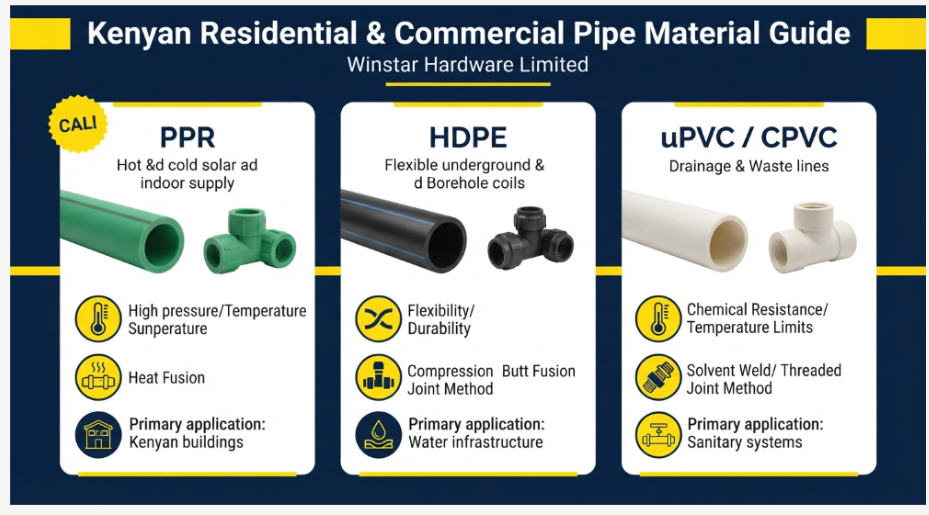
Modern Kenyan plumbing relies on specialized polymers engineered for distinct pressure, temperature, and drainage roles. Specifically, matching the right thermoplastic resin to each building zone ensures peak hydraulic efficiency. Meanwhile, suppliers like Winstar Hardware Limited help builders pair each pipe material with its exact compatible accessories.
2.1 PPR Pipes: Selecting Premium Pipes and Fittings for Lifetime Durability in Hot and Cold Water Systems
- Thermal resilience: Polypropylene Random Copolymer handles continuous hot water up to 70°C and short peaks up to 95°C.
- Homogeneous joints: Socket heat fusion melts pipe and fitting together into one continuous, leak-free plastic piece.
- Noise reduction: Thick polymer walls dampen water flow noise inside bedroom and bathroom chases.
- Hygienic safety: Food-grade virgin PPR resin imparts zero taste or odor to potable household water.
Heat fusion jointing technology and PN20 pressure ratings
- Solar compatibility: PN20-rated PPR lines safely carry pressurized hot water from rooftop solar collectors to showers.
- High burst resistance: Thick PN20 walls withstand 20 bars of nominal cold-water pressure without deforming.
2.2 HDPE Pipes: Flexible Solutions for Boreholes, Irrigation, and Municipal Mains
- Long coil lengths: High-Density Polyethylene arrives in continuous 50-meter or 100-meter coils, drastically reducing underground joint counts.
- Impact toughness: Heavy-duty coils endure rough handling on rocky Kenyan construction sites without cracking.
- Borehole drop pipes: High tensile strength supports submerged pump columns in deep domestic and farm boreholes.
- Agricultural efficiency: Drip and sprinkler networks rely on HDPE sub-mains for consistent field pressure.
For a clear look at how larger polyethylene lines are joined, open Butt-fusion jointing of polyethylene (PE) pipes to see the butt-fusion process in action.
PE100 resin grades, UV resistance, and butt-fusion joints
- Superior density: PE100 material offers higher pressure resistance with thinner walls than older PE80 grades.
- Carbon black shielding: Integrated UV stabilizers protect exposed surface farm pipes from equatorial sunlight degradation.
- Butt-fusion strength: Heated plate welding joins large-diameter mains with zero mechanical weak points.
2.3 uPVC and CPVC Pipes: Drainage, Sewerage, and High-Temperature Alternatives
- Gravity drainage: Unplasticized PVC smoothly evacuates greywater and blackwater from sinks, toilets, and roof gutters.
- Chemical immunity: Household detergents, bleach, and waste acids do not corrode uPVC walls.
- Cold mains: Blue or grey pressure-rated uPVC serves cost-effectively for underground cold-water distribution.
- High-heat CPVC: Chlorinated PVC provides an alternative solvent-welded option for hot-water risers where welding power is unavailable.
Comparing grey uPVC waste systems against chlorinated CPVC
- Temperature limits: Standard grey uPVC deforms above 60°C, whereas CPVC safely tolerates boiling-range domestic discharges.
- Installation speed: Both systems use specialized solvent cements that cure rapidly for quick site progress.
For a side-by-side breakdown of how these thermoplastics compare in heat tolerance, soil flexibility, and upfront cost, explore this detailed guide on how to choose the right pipes for your Kenyan home.
The Critical Role of Fittings, Valves, and Joints in System Longevity
A pipeline is only as strong as its weakest elbow, tee, or isolation valve. Therefore, smart contractors never pair high-grade pipes with cheap, unbranded connectors. Above all, precision-molded fittings preserve smooth water flow and prevent turbulent pressure drops.
3.1 Why 80% of Plumbing Leaks Originate at Joint Connections
- Improper alignment: Forcing angled pipes into straight sockets creates permanent mechanical stress at the collar.
- Dirty surfaces: Dust, oil, or moisture on pipe ends prevents complete molecular bonding during fusion or solvent welding.
- Over-tightening: Excessive wrench torque cracks female plastic threads when connecting metal taps.
- Thermal expansion: Uncompensated length changes pull poorly anchored joints apart over repeated heating cycles.
Thermal expansion stress, poor solvent cement curing, and thread tolerances
- Expansion loops: Long hot-water PPR runs need proper clips and offsets to absorb natural thermal expansion.
- Curing patience: Pressurizing solvent-welded uPVC joints too early blows out unhardened adhesive bonds.
3.2 Matching Material Grades with Premium Pipes and Fittings for Lifetime Durability
- Unified polymers: Using the exact same resin grade for pipes and fittings guarantees identical thermal expansion rates.
- Heavy brass inserts: Quality transition elbows feature knurled, nickel-plated brass threads that never spin loose inside plastic housings.
- Full-bore valves: PPR ball valves and brass gate valves allow unrestricted flow and smooth quarter-turn shutoff.
- Compression seals: Rubber O-ring compression fittings let farmers assemble and service HDPE lines without electricity.
Brass-inserted PPR elbows, compression HDPE couplers, and gate valves
- Wall-plate security: Wing-back brass elbows anchor firmly to masonry walls so shower arms stay rigid.
- Non-rising stems: Compact cast-brass gate valves fit neatly inside recessed bathroom inspection boxes.
KEBS and International Standards Behind Premium Pipes and Fittings for Lifetime Durability
Regulatory standards separate engineered building materials from hazardous counterfeit stock. Consequently, checking certification stamps before paying ensures you actually receive premium pipes and fittings for lifetime durability. Moreover, compliant materials satisfy county building inspectors and project engineers across Kenya.
4.1 Decoding KEBS Standardization Marks (SM) and Diamond Marks of Quality
- Mandatory SM mark: Every locally manufactured pipe sold in Kenya must display the official Kenya Bureau of Standards Standardization Mark.
- Import ISM mark: Imported specialty pipes require an Import Standardization Mark verifying pre-shipment quality testing.
- Diamond Mark: This prestigious symbol confirms continuous factory surveillance and superior manufacturing consistency.
- Digital verification: Buyers can verify permit numbers instantly via the official KEBS SMS code at the hardware counter.
Verifying genuine certification codes via SMS and USSD
- Instant authenticity: Sending the permit number printed on the pipe wall to KEBS confirms valid manufacturer licensing.
- Batch traceability: Genuine pipes carry clear ink-jet stamps showing production date, shift code, and nominal pressure.
4.2 DIN 8077/8078, ISO 15874, and EN Standards Explained for Kenyan Buyers
- DIN 8077/8078: German industrial standards govern exact outer diameters, wall thicknesses, and long-term pressure resistance for PPR pipes.
- ISO 15874: International guidelines specify fitness-for-purpose testing for polypropylene hot and cold water installations.
- ISO 4427: This global benchmark regulates PE80 and PE100 polyethylene pipes used in pressurized water supply networks.
- EN 1401: European standards ensure underground uPVC sewer pipes resist heavy soil loads without oval deflection.
Wall thickness tolerances (SDR ratings) and 50-year hydrostatic testing
- SDR meaning: Standard Dimension Ratio divides pipe outer diameter by wall thickness; lower SDR numbers mean thicker, stronger walls.
- Accelerated aging: Certified pipes pass grueling high-temperature laboratory pressure tests simulating 50 years of continuous service.
Spotting Counterfeit vs. Genuine Plumbing Supplies in Kenyan Hardware Stores
Illicit manufacturers frequently imitate trusted brand colors and packaging to trick hurried buyers. However, learning simple visual and physical checks helps you secure premium pipes and fittings for lifetime durability every time. Furthermore, buying from reputable stockists eliminates the risk of unbranded factory rejects entering your site.
5.1 Physical Inspection Checklist for Premium Pipes and Fittings for Lifetime Durability
- Smooth bore finish: Genuine virgin-resin pipes feel silky inside and out with zero pitting or rough bumps.
- Uniform concentricity: Look at the cut pipe end to verify even wall thickness all around the circle.
- Crisp markings: Authentic branding, pressure class, and KEBS codes resist scratching and never smudge easily.
- Exact socket depth: Genuine fittings hold pipes snugly before heating rather than feeling loose or overly tight.
Checking virgin resin sheen, uniform wall concentricity, and laser stamps
- Light transmission test: Shining a bright phone torch against a green PPR pipe reveals opaque density; overly translucent walls let light in and promote algae growth.
- Consistent color: Virgin materials exhibit rich, uniform coloration without dark streaks or recycled specks.
5.2 Red Flags of Recycled Plastic Blends and Under-Gauged Pipe Walls
- Chalky appearance: Dull, dusty surfaces indicate excessive calcium carbonate filler added to cut manufacturing costs.
- Acrid welding smoke: Burning or foul chemical odors during PPR heat fusion expose degraded recycled scrap plastics.
- Brittle snapping: Dropping a genuine HDPE or PPR offcut causes it to bounce, whereas recycled blends crack sharply.
- Missing pressure ratings: Avoid any unlabeled pipe lacking clear PN, SDR, or manufacturer contact stamps.
Brittle textures, foul chemical odors, and irregular socket depths
- Uneven melting: Recycled polymers melt unpredictably on welding dies, creating weak cold joints that leak under test pressure.
- Thin brass rings: Counterfeit transition fittings use paper-thin brass inserts that strip immediately during tap installation.
Climate and Regional Plumbing Considerations Across Kenya
Kenya’s diverse geography exposes building materials to vastly different environmental stressors from the coast to the highlands. Accordingly, adapting your material specifications to local weather and water chemistry delivers premium pipes and fittings for lifetime durability in every county. Thus, regional builders prevent premature failures caused by salt air, intense UV rays, or cold mountain nights.
6.1 Coastal Salinity and High Ambient Heat in Mombasa, Kilifi, and Kwale
- Salt-air corrosion: Humid coastal breezes rapidly rust exposed steel pipes, metallic clamps, and low-grade brass valves.
- Polymer immunity: All-plastic PPR and HDPE networks remain completely unaffected by saline air and coastal groundwater.
- High ambient heat: Warm year-round temperatures slightly reduce plastic pressure ratings, making PN20 PPR advisable even for cold lines.
- UV shielding: Intense coastal sunshine degrades unprotected white PVC pipes within months unless shaded or painted.
Eliminating galvanized iron rusting with non-corrosive polymer systems
- Plastic pipe clips: Using UV-stabilized polymer saddles instead of mild-steel brackets prevents rust stains on exterior coastal walls.
- Composite valves: Corrosion-resistant polymer and DZR brass valves ensure smooth shutoff despite salty water.
6.2 Highland Cold-Weather Thermal Stress and Premium Pipes and Fittings for Lifetime Durability
- Thermal contraction: Chilly nights in Nyeri, Limuru, and Eldoret cause exposed pipes to contract significantly after warm sunny afternoons.
- Booster pump surges: Multi-storey homes in hilly towns rely on high-head pumps that stress weak joints.
- Insulation needs: Lagging hot-water risers prevents rapid heat loss and keeps morning showers warm.
- Frost protection: High-altitude farms near Mount Kenya should bury shallow irrigation pipes at least 450 millimeters deep.
Managing thermal contraction and high-pressure booster pumps
- Flexible connectors: Braided stainless hoses isolate rigid PPR manifolds from pump vibration.
- Pressure vessels: Diaphragm tanks absorb pump start-stop spikes and extend valve lifespans.
Installation Best Practices That Protect Your Piping Investment
Even the finest factory-certified materials fail if technicians rush joint assembly or skip site testing. Consequently, enforcing strict workmanship standards guarantees you achieve premium pipes and fittings for lifetime durability across your entire project. Furthermore, supervising key installation milestones saves homeowners from expensive post-completion rework.
7.1 Proper Fusion Welding and Trenching for Premium Pipes and Fittings for Lifetime Durability
- Exact die temperature: Set PPR fusion machines strictly to 260°C and wait for the ready indicator light.
- Square cuts: Use sharp ratchet pipe cutters so pipe ends sit flat against fitting stops.
- No twisting: Push pipe and fitting straight together without rotating, then hold steady during cooling.
- Clean trenches: Remove sharp stones from underground trenches before laying HDPE mains.
Maintaining 260°C PPR heating temperatures and sand-bedding trenches
- Depth markings: Mark insertion depth with a pencil so over-pushed plastic does not melt shut and choke water flow.
- Sand cushion: Surround buried pipes with 100 millimeters of fine river sand to distribute heavy vehicle loads evenly.
Watch a quick visual walkthrough of PPR Pipe Welding Machine | Plumbing PPR Pipe Fitting Work to see how technicians align pipes and fittings for heat fusion.
7.2 Mandatory Hydrostatic Pressure Testing Before Plastering Walls
- Pre-concealment rule: Never allow masons to plaster wall chases or pour concrete screeds before pressure testing.
- Test pressure: Pump the sealed network to 1.5 times its normal working pressure using a calibrated test pump.
- Holding period: Monitor the pressure gauge for at least two hours while inspecting every fused and threaded joint.
- Photographic record: Take clear photos of tested wall routes so future carpenters never drill into hidden pipes.
Step-by-step pressure gauge verification protocols before masonry work
- Air bleeding: Open the highest tap while filling the system so trapped air escapes completely before pressurizing.
- Immediate fixes: Cut out and replace any weeping joint immediately rather than applying surface sealant.
Buyer’s Evaluation Criteria for Premium Pipes and Fittings for Lifetime Durability
Moving from technical awareness to purchasing requires a structured framework for comparing local suppliers and product lines. Specifically, evaluating lifecycle economics alongside warranty support ensures you invest wisely in premium pipes and fittings for lifetime durability. Additionally, partnering with established hardware distributors simplifies logistics for multi-phase residential and commercial projects.
8.1 Balancing Upfront Cost Per Meter Against 50-Year Lifecycle Value
- Small price gap: Genuine KEBS-certified pipes typically cost only 15% to 25% more than unbranded economy alternatives.
- Plumbing budget share: Pipes and fittings represent under 5% of total house construction costs yet carry huge failure risks.
- Zero replacement cost: A single burst pipe repair easily exceeds the total upfront savings of buying cheap piping.
- Higher efficiency: Smooth internal bores reduce pump electricity consumption over decades of daily operation.
Cost-per-year comparison between budget recycled pipes and virgin-grade systems
- Amortized value: Dividing the cost of virgin PPR across 50 years yields pennies per day for uninterrupted peace of mind.
- Predictable budgeting: Reliable infrastructure frees property owners to invest in upgrades rather than emergency repairs.
8.2 Evaluating Manufacturer Warranties, Technical Support, and Nationwide Availability
- Written guarantees: Leading Kenyan and international manufacturers back certified systems with 10-to-50-year defect warranties.
- Complete ecosystems: Choose brands offering every diameter, valve, and transition fitting needed for your blueprint.
- Technical guidance: Reputable suppliers provide pressure-rating advice and fusion tool support for site plumbers.
- Stock continuity: Nationwide availability ensures easy matching if you expand your building years later.
Sourcing complete system ecosystems from authorized distributors
- Single-brand integrity: Keeping pipes and fittings within one manufacturer ecosystem preserves full warranty coverage.
- Trusted stockists: Retailers like Winstar Hardware Limited pre-verify certification marks so contractors receive authentic stock.
Top 15 Pipe and Fitting Brands in Kenya Ranked by Reliability and Reach
Kenya’s plumbing market features both world-class domestic factories and globally respected European piping innovators. Consequently, comparing these top brands helps you select premium pipes and fittings for lifetime durability matched to your project scale and budget. Below, we rank the top 15 brands trusted by Kenyan engineers, plumbers, and homeowners.
9.1 Leading Local Manufacturers Offering Premium Pipes and Fittings for Lifetime Durability
- Domestic advantage: Kenyan factories produce fresh stock tailored to local KEBS standards without international shipping delays.
- Custom lengths: Local plants supply long HDPE coils and specialized drainage diameters directly to project sites.
- Competitive pricing: Domestic manufacturing eliminates import duties while maintaining strict ISO quality control.
- Broad distribution: Major Kenyan brands maintain ready stock across hardware hubs nationwide.
#1 General Industries Limited (GIL)
- Half-century legacy: Operating for over 50 years, GIL manufactures KEBS-certified uPVC, PPR, and HDPE piping systems across Kenya.
- Broad product scope: Their catalog covers domestic water supply, agricultural irrigation, borehole casings, and heavy drainage.
#2 Apex Piping Systems (Hydro-Flo)
- Virgin-resin focus: Apex produces Hydro-Flo PPR, HDPE, and uPVC systems engineered for a 50-year service lifespan.
- Precision fittings: Their matching brass-inserted fittings and fusion tools deliver reliable leak-free residential plumbing.
#3 Danco Capital Limited (Aquaflo)
- Infrastructure scale: Danco supplies ISO- and KEBS-certified HDPE and PPR pipes used in both homes and county water projects.
- Consistent extrusion: Automated production lines ensure uniform wall thickness and accurate pressure ratings across batches.
#4 Top Pipe Limited
- Specialized engineering: Top Pipe excels in double-wall corrugated (DWC) sewer pipes, spiral HDPE, and in-wall PPR systems.
- High load strength: Their heavy-duty drainage lines handle deep underground civil and commercial estate installations.
#5 Metro Concepts East Africa Ltd
- Regional reach: With over four decades of experience, Metro Concepts supplies industrial-grade PVC, PPR, and HDPE networks.
- Reliable availability: Contractors easily source their standardized fittings across major Kenyan towns.
#6 Plastico Industries Limited
- Comprehensive range: Plastico manufactures heavy-duty uPVC waste pipes, pressure mains, borehole screens, and PPR lines.
- Strict testing: Every production batch undergoes hydrostatic pressure and impact checks before dispatch.
#7 Conix Industries Limited
- Residential focus: Conix delivers dependable plastic plumbing, electrical conduits, and rainwater drainage solutions for Kenyan builders.
- Value engineering: Their products balance affordability with full KEBS compliance for housing developments.
#8 Eslon Plastics of Kenya Ltd
- Pioneering heritage: As one of Kenya’s earliest plastic pipe makers, Eslon maintains strong trust for uPVC pressure and waste systems.
- Consistent dimensions: Plumbers value Eslon pipes for exact socket tolerances and dependable solvent-weld performance.
#9 Pipe Manufacturers Ltd
- Industrial Area hub: Based in Nairobi, this manufacturer specializes in uPVC and HDPE water conveyance pipes for estates and farms.
- Fast turnaround: High local production capacity supports tight contractor delivery schedules.
#10 Megapipes Solutions Limited
- 100-year design life: Megapipes manufactures large-diameter Weholite structured-wall HDPE pipes engineered for century-long infrastructure durability.
- Civil excellence: Ideal for stormwater attenuation tanks, municipal sewers, and highway culverts.
9.2 Top Imported and Specialty Brands Trusted by Kenyan Contractors
- European precision: Imported specialty brands dominate luxury apartments, hospitals, and high-pressure commercial towers.
- Advanced polymers: Many global leaders offer PP-RCT and multi-layer composite pipes with superior high-temperature strength.
- ISM verification: Always confirm the KEBS Import Standardization Mark on imported cartons.
- Specialized valves: Global piping brands provide precision electrofusion couplers and balancing valves.
#11 Aquagas Plastics (PP-RCT & PPR)
- Certified performance: Aquagas supplies internationally certified (DIN/EN) PPR and PP-RCT pipes widely favored by Kenyan plumbers.
- Smooth fusion: Technicians praise Aquagas pipes for clean, consistent melting during socket welding.
#12 Wavin (Pilsa / Tigris Systems)
- Global innovation: Wavin’s Pilsa PPR and Tigris multi-layer systems bring European acoustic and thermal engineering to Kenyan towers.
- Hygienic reliability: Hospitals and hotels specify Wavin for silent, corrosion-free potable water risers.
#13 Georg Fischer (+GF+) Piping Systems
- Industrial benchmark: Swiss-engineered +GF+ valves, electrofusion HDPE fittings, and industrial systems set the gold standard for critical pipelines.
- Zero-leak precision: Commercial water treatment plants and factories rely on +GF+ for exact flow control.
#14 Banninger Kunststoff-Produkte
- German engineering: Banninger manufactures high-spec PP-R and PP-RCT pipes built to endure continuous high-pressure hot water loops.
- Long-term stability: Certified to rigorous German DIN standards for demanding commercial plumbing.
#15 RWC / John Guest
- Push-fit speed: John Guest push-fit polymer and brass transition fittings allow rapid, tool-free connections in tight maintenance spaces.
- Retrofit versatility: Ideal for connecting modern PEX or PPR lines to existing commercial fixtures cleanly.
Estimating Plumbing Budgets and Sourcing Authentic Stock in Kenya
Accurate material estimation prevents mid-project shortages and protects your construction cash flow. Therefore, reviewing typical house ratios helps you budget realistically for premium pipes and fittings for lifetime durability before visiting a supplier. Meanwhile, sourcing from verified hardware partners guarantees genuine factory stock at transparent wholesale prices.
10.1 Sample Bill of Quantities (BoQ) Ratios for a Standard 3-Bedroom Kenyan Home
- Internal supply (35%): PN20 PPR pipes (20mm to 32mm) and brass transition fittings for bathrooms, kitchen, and solar lines.
- Waste and soil (30%): Grey uPVC pipes (40mm to 110mm), inspection bends, floor traps, and gullies.
- External mains (20%): PN10 or PN12.5 HDPE coils (25mm to 32mm) linking the county meter, underground tank, and booster pump.
- Valves and sundries (15%): Brass gate valves, non-return check valves, pipe clips, thread tape, and solvent cement.
Typical percentage allocation across internal PPR, external HDPE, and uPVC waste
- Contingency buffer: Add a 10% allowance for offcuts, vertical drops, and minor layout adjustments during rough-in.
- Bundled savings: Purchasing your entire BoQ from one supplier unlocks bulk contractor discounts.
Once your budget percentages are set, review this itemized checklist covering foundation to rooftop plumbing supplies for a durable Kenyan home so no critical valve, clamp, or transition fitting gets left off your order.
10.2 Where to Buy Premium Pipes and Fittings for Lifetime Durability Direct from Factory Depots
- Nairobi Industrial Area: Enterprise Road and Lunga Lunga Road host major factory depots and specialized plumbing wholesalers.
- Mombasa Road corridor: Conveniently serves projects in Syokimau, Kitengela, Athi River, and Machakos County.
- Regional wholesale hubs: Authorized distributors in Nakuru, Eldoret, Kisumu, and Mombasa stock full manufacturer ranges.
- One-stop convenience: Partnering with Winstar Hardware Limited gives buyers direct access to verified brands, valves, and pumps under one roof.
Navigating Nairobi Industrial Area, Mombasa Road, and regional hubs
- Request delivery notes: Always demand itemized tax invoices listing exact pipe brands, diameters, and pressure classes.
- Inspect upon offload: Verify KEBS stamps on every bundle before signing driver delivery forms.
Preventive Maintenance for Premium Pipes and Fittings for Lifetime Durability
Even the strongest plumbing network benefits from simple annual inspections that catch minor wear early. Accordingly, routine care preserves peak water pressure and extends the life of premium pipes and fittings for lifetime durability for generations. Furthermore, proactive maintenance prevents sudden weekend plumbing emergencies.
11.1 Routine Pressure Regulator Checks and Hard-Water Descaling Schedules
- Valve exercising: Turn main gate valves and isolation stopcocks off and on twice yearly so mineral deposits never seize stems.
- Strainer cleaning: Flush Y-strainers ahead of booster pumps every six months to clear sand and borehole grit.
- Pressure monitoring: Check pressure-reducing valves annually to ensure incoming municipal pressure stays below 4 bars.
- Aerator descaling: Soak tap aerators and showerheads in mild vinegar solution to remove hard-water calcium buildup.
Protecting valves and mixer cartridges from sediment buildup
- Inline sediment filters: Installing a washable mesh filter after the storage tank protects expensive ceramic mixer cartridges.
- Tank washing: Drain and scrub overhead and underground water tanks annually to prevent silt from entering supply risers.
11.2 Seasonal Drainage Flushing and Outdoor UV Protection Audits
- Pre-rain clearing: Clean roof gutters, downpipes, and yard storm gullies every February before Kenya’s March–May long rains.
- Grease trap care: Flush kitchen waste lines monthly with hot water and biodegradable cleaners to prevent fat blockages.
- UV paint touch-ups: Repaint exposed exterior PVC or PPR risers with exterior acrylic paint to block solar UV rays.
- Clip inspections: Tighten loose wall brackets on outdoor vertical stacks so wind vibration never stresses joints.
Clearing storm gullies before long rains and sleeving outdoor risers
- Foam lagging: Wrap exposed rooftop solar pipes with UV-resistant closed-cell foam insulation.
- Rodding eye access: Keep exterior sewer inspection covers clear of paving slabs for effortless maintenance.
Frequently Asked Questions from Kenyan Homeowners and Contractors
Buyers often encounter conflicting advice from local hardware attendants and site technicians. Therefore, these clear answers help you specify premium pipes and fittings for lifetime durability with complete confidence.
12.1 Can You Mix Different Brands of PPR Pipes and Fittings Safely?
- Avoid mixing: Different manufacturers use slightly varied polypropylene melt-flow indexes and outer-diameter tolerances.
- Joint integrity: Mixing brands can cause uneven melting during fusion welding, increasing long-term leak risks.
- Warranty protection: Most manufacturers void product warranties if non-matching fittings are fused onto their pipes.
Melt-flow index compatibility and warranty voidance risks
- Single-system rule: Always purchase pipes, elbows, tees, and valves from the exact same brand family.
- Transition adapters: Use proper brass threaded adapters when connecting PPR lines to existing PVC or metal networks.
12.2 Which Pipe Pressure Rating (PN16 vs. PN20) Is Best for Multi-Storey Buildings?
- Choose PN20: Multi-storey apartments and homes with booster pumps should standardize on thick-walled PN20 PPR pipes.
- Hot-water durability: PN20 handles elevated temperatures and pressure spikes far safer than thinner PN16 pipes.
- Minimal cost difference: Upgrading from PN16 to PN20 adds very little to total material cost while doubling safety margins.
Selecting PN20 for pumped risers and hot-water solar loops
- Solar feed lines: Always use PN20 on both cold inlet and hot outlet lines serving rooftop solar heaters.
- Ground-floor risers: High static head pressure on lower floors demands heavy PN20 wall strength.
12.3 How Long Do KEBS-Certified Polymer Pipes Last Underground?
- 50-to-100-year lifespan: Properly installed KEBS-certified HDPE and uPVC pipes last over five decades underground.
- Zero soil rot: Unlike metal pipes, thermoplastics never rust, rot, or suffer galvanic corrosion in damp earth.
- Proper bedding: Longevity depends on burying pipes below traffic impact zones inside clean sand bedding.
Expected 50-to-100-year service life under proper trench bedding
- Warning tape: Laying metallic-backed warning tape 300 millimeters above buried mains prevents accidental excavation damage.
- Trusted guidance: Choose premium pipes and fittings for lifetime durability in Kenya, explore KEBS standards, material guides, and top 15 brands, and consult Winstar Hardware Limited for authentic project supplies.