


Kenyan construction projects face severe financial risks when contractors install substandard pipes or weak valves. Choosing certified plumbing supplies for construction projects protects your building structure and guarantees long-term water reliability. Furthermore, compliant materials prevent costly post-handover repairs across residential and commercial sites. Smart developers prioritize verified quality from day one to safeguard every shilling invested in modern infrastructure.
1. Why Certified plumbing supplies for construction projects Matter in Kenya
Substandard piping compromises structural integrity across rapidly growing Kenyan urban centers. Therefore, engineers must prioritize certified plumbing supplies for construction projects before breaking ground on any site. Proper material selection also ensures full legal compliance with national building authorities.
1.1 Mitigating Structural Water Damage and Costly Rework
- Water leaks inside concrete slabs weaken steel reinforcement and destroy interior finishes.
- Consequently, developers spend millions breaking floors to replace cheap, unverified fittings.
- Using certified plumbing supplies for construction projects eliminates premature failure and protects project profit margins.
#1 Preventing burst pipes and hidden slab leaks in multi-story builds
- High-rise apartments in Nairobi place immense hydrostatic pressure on concealed vertical risers.
- Specifically, verified pipes resist sudden pressure spikes without cracking behind tiled walls.
- Additionally, contractors avoid embarrassing tenant complaints and expensive structural remediation after project handover.
#2 Eliminating premature joint failure under high municipal water pressure
- Municipal water supply lines often fluctuate sharply between low flow and high night-time surges.
- However, precision-molded joints hold tight without weeping or blowing apart under sudden stress.
- As a result, building managers maintain consistent water delivery across every floor around the clock.
1.2 Navigating Kenyan Regulatory Compliance and Safety Standards
- Kenyan construction laws strictly enforce material quality to protect public health and safety.
- Moreover, building inspectors reject sites that use unapproved or counterfeit plumbing components.
- Sourcing certified plumbing supplies for construction projects guarantees smooth approvals during every construction phase.
#3 Meeting Kenya Bureau of Standards (KEBS) Diamond Mark requirements
- The Kenya Bureau of Standards tests plumbing products for chemical safety and burst strength.
- Therefore, genuine pipes carry the official KEBS Diamond Mark of Quality along their outer walls.
- In addition, verified potable water pipes prevent toxic heavy metals from leaching into drinking water.
#4 Passing National Construction Authority (NCA) site inspections effortlessly
- National Construction Authority officers audit material compliance on active Kenyan building sites.
- Consequently, documented proof of certified materials speeds up statutory sign-offs and occupancy certificates.
- Contractors also avoid costly project suspensions and regulatory fines during routine government site visits.
2. Core Piping Systems for Kenyan Residential and Commercial Builds
Modern buildings require specialized piping networks tailored to specific water temperatures, pressures, and waste loads. Hence, quantity surveyors must match each pipe material to its exact engineering application. Selecting the right system maximizes durability across decades of daily building occupancy.
2.1 Selecting Certified plumbing supplies for construction projects by Pipe Material
- Different zones within a construction site demand distinct polymer densities and thermal tolerances.
- Accordingly, engineers specify certified plumbing supplies for construction projects based on fluid type and installation depth.
- Combining compatible pipe families creates a seamless, leak-free reticulation network throughout the property.
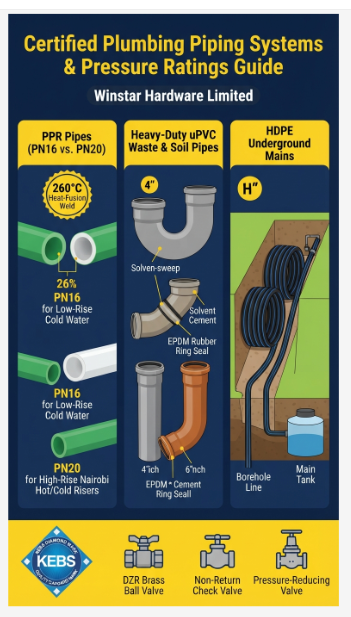
#5 High-pressure PPR pipes for hot and cold potable water lines
- Polypropylene Random Copolymer (PPR) pipes handle both boiling solar-heated water and cold supply lines.
- Furthermore, their smooth inner walls prevent limescale buildup and preserve strong water flow rates.
- Installers also appreciate how lightweight PPR lengths speed up internal wall chasing and ceiling runs.
#6 Heavy-duty uPVC drainage and waste soil pipes
- Unplasticized Polyvinyl Chloride (uPVC) pipes transport greywater and blackwater safely away from occupied rooms.
- Specifically, thick-walled soil stacks resist chemical corrosion from harsh household detergents and sewage gases.
- Meanwhile, wide-sweep bends prevent solid waste blockages inside vertical drainage shafts.
#7 HDPE piping for underground mains and borehole reticulation
- High-Density Polyethylene (HDPE) pipes flex easily over rocky Kenyan terrain without snapping under soil loads.
- Because they resist ground movement and tree root intrusion, HDPE lines excel in underground trenches.
- They also connect deep boreholes to main storage tanks with zero water loss.
2.2 Matching Pressure Ratings (PN) to Building Height
- Tall structures generate massive static head pressure at lower basement and ground levels.
- Thus, plumbers must calculate vertical elevation before ordering pipe wall thicknesses.
- Undersized pressure ratings inevitably lead to catastrophic pipe ruptures on lower floors.
#8 Specifying PN16 vs. PN20 pipes for high-rise Nairobi apartments
- PN16 pipes perform reliably for standard cold-water distribution in low-rise residential homes.
- Conversely, PN20 pipes feature thicker walls engineered for high-pressure risers and hot-water lines.
- Therefore, multi-story towers in Westlands or Kilimani require PN20 specifications for total peace of mind.
#9 Calculating thermal expansion allowances in exposed rooftop risers
- Intense equatorial sunlight causes exposed rooftop pipes to expand and contract daily.
- Consequently, plumbers install expansion loops and heavy-duty pipe clips to absorb linear movement safely.
- Without proper allowance, thermal stress warps straight pipe runs and strains rigid wall connections.
- For additional pipe, valve, and pressure-system recommendations tailored to local builds, explore our guide on flowing solutions for Nairobi and beyond
3. Valves, Fittings, and Jointing Integrity
Even the strongest pipe fails if cheap valves or weak joints compromise the connection points. Therefore, smart contractors invest heavily in precision-engineered flow control hardware. Reliable fittings allow technicians to isolate zones quickly during routine building maintenance.
3.1 Brass and Stainless-Steel Flow Control Components
- Metallic valves endure constant mechanical turning and high water friction over many years.
- Moreover, quality alloys resist rust and mineral seizure in hard-water regions across Kenya.
- Installing certified plumbing supplies for construction projects keeps isolation points operational during emergencies.
#10 Dezincification-resistant (DZR) brass gate and ball valves
- Standard low-grade brass loses zinc in aggressive water, turning brittle and porous over time.
- In contrast, DZR brass alloys maintain full structural strength and smooth quarter-turn operation.
- Plumbers rely on DZR ball valves for main isolation points and pump room manifolds.
#11 Non-return check valves to protect booster pumps from backflow
- Booster pumps suffer severe impeller damage when water rushes backward during power outages.
- Accordingly, spring-loaded non-return valves slam shut instantly to block reverse water flow.
- They also prevent contaminated tank water from flowing back into municipal supply lines.
#12 Pressure-reducing valves (PRVs) for lower-floor apartment zones
- Gravity feeds create excessive water pressure on the bottom floors of tall apartment blocks.
- Therefore, pressure-reducing valves step down incoming force to protect taps, mixers, and geysers.
- As a result, residents enjoy gentle, splash-free water flow on every single floor.
3.2 Leak-Free Jointing with Certified plumbing supplies for construction projects
- Every elbow, tee, and reducer represents a potential weak point if joined carelessly.
- However, pairing certified plumbing supplies for construction projects with strict fusion standards creates permanent bonds.
- Proper jointing transforms individual pipe lengths into one continuous, monolithic pressure vessel.
#13 Proper heat-fusion welding temperatures for PPR sockets
- PPR fusion machines must heat both pipe and fitting to exactly 260 degrees Celsius.
- When heated properly, the melted polymers fuse into a single homogeneous joint without internal ridges.
- Overheating narrows the pipe bore, while underheating creates weak cold joints that leak later.
#14 Industrial-grade solvent cements and EPDM rubber ring seals
- Heavy-duty uPVC drainage joints require high-solids solvent cement for permanent chemical welding.
- Meanwhile, push-fit underground drains rely on flexible EPDM rubber rings to absorb ground vibration.
- Using genuine sealants prevents foul sewer odors from escaping into bathrooms and kitchens.
4. Water Storage, Pumping, and Drainage Solutions
Reliable water storage and efficient waste disposal define modern living standards in Kenyan developments. Hence, builders must integrate robust tanks, float controls, and sanitary rough-ins into their designs. Well-planned hydraulic systems ensure uninterrupted water availability during dry spells.
4.1 Integrating Certified plumbing supplies for construction projects into Water Harvesting
- Rainwater harvesting and borehole storage reduce reliance on erratic municipal water schedules.
- Furthermore, using certified plumbing supplies for construction projects keeps stored water clean and algae-free.
- Smart tank accessories also prevent wasteful overflows onto rooftops and paved compounds.
#15 UV-stabilized food-grade overhead and underground storage tanks
- Rotomolded polyethylene tanks with UV-stabilized outer layers block harsh Kenyan sunlight from heating water.
- Inside, virgin food-grade lining prevents bacterial growth and keeps drinking water fresh.
- For underground installations, ribbed heavy-duty tanks resist external soil pressure without buckling.
#16 Heavy-duty float valves and tank connectors for zero-overflow operation
- Cheap plastic float valves snap easily under high mains pressure, flooding rooftops and wasting thousands of liters.
- Instead, brass-arm equilibrium float valves shut off water smoothly once the tank reaches capacity.
- Additionally, double-flanged tank connectors create watertight seals around tank outlets without cracking the plastic wall.
4.2 Foul Water, Stormwater, and Sanitary Ware Rough-Ins
- Effective drainage protects foundations from heavy seasonal rains and prevents unsanitary blockages.
- Moreover, accurate rough-in measurements ensure luxury sanitary ware fits cleanly during final finishing.
- Durable underground chambers simplify long-term sewer maintenance for property management teams.
#17 Inspection chambers, gully traps, and heavy-duty manhole covers
- Pre-molded plastic or concrete inspection chambers give plumbers easy rodding access at pipe junctions.
- Meanwhile, water-sealed gully traps block sewer gases from rising through outdoor kitchen and laundry drains.
- In driveways, ductile iron manhole covers support heavy delivery trucks without cracking.
#18 Concealed cistern frames and commercial-grade ceramic sanitary fittings
- Wall-hung toilets require rigid steel concealed cistern frames anchored securely into structural masonry.
- Furthermore, using certified plumbing supplies for construction projects behind tiled walls prevents hidden cistern leaks.
- Commercial-grade dual-flush mechanisms also cut building water consumption significantly over time.
5. How to Verify Authenticity and Avoid Counterfeits in Nairobi
Counterfeit building materials pose a serious threat to unsuspecting buyers across Nairobi hardware markets. Therefore, site engineers must inspect every delivery rigorously before signing goods-received notes. Vigilant verification stops fake pipes and underweight valves from entering your project.
5.1 Physical Inspection Checklist for Site Engineers and Quantity Surveyors
- Visual and tactile checks quickly expose inferior knock-offs on busy construction sites.
- Consequently, storekeepers should verify markings and wall gauges against approved sample boards.
- Rejecting suspicious batches at the gate saves weeks of troubleshooting later.
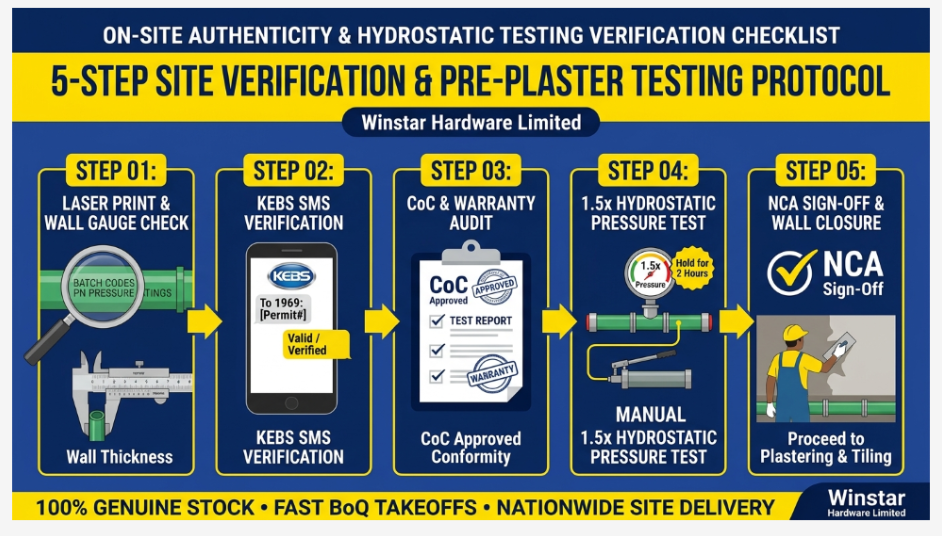
#19 Checking laser-printed batch codes, pressure ratings, and wall thickness
- Authentic pipes display crisp, indelible laser printing showing brand name, diameter, PN rating, and production date.
- Conversely, fake pipes often feature blurry ink stamps that rub off easily with a damp cloth.
- Using digital vernier calipers also confirms that wall thickness matches official standard dimensions.
#20 Verifying KEBS standardization marks via SMS verification codes
- Genuine certified products carry unique permit numbers beneath the KEBS standardization mark.
- Site managers can send the permit code to the official KEBS SMS verification platform on-site.
- Within seconds, the system confirms whether the manufacturer license remains valid and active.
5.2 Documentation Backing Certified plumbing supplies for construction projects
- Physical stamps alone are insufficient for large commercial tenders and institutional audits.
- Accordingly, reputable suppliers provide complete paperwork for all certified plumbing supplies for construction projects.
- Maintaining an organized quality-assurance file protects contractors during consultant handovers.
#21 Requesting manufacturer Certificates of Conformity (CoC) and test reports
- Authorized distributors issue batch-specific Certificates of Conformity alongside every major delivery invoice.
- Additionally, factory hydrostatic and tensile test reports prove the batch passed rigorous laboratory stress checks.
- Quantity surveyors attach these certificates to interim payment valuations for consultant approval.
#22 Ensuring valid warranty coverage for commercial developer handovers
- Leading plumbing manufacturers back their genuine systems with multi-year material defect warranties.
- However, warranties remain valid only when buyers purchase through authorized supply channels.
- Documented warranty certificates boost buyer confidence when selling residential apartments or commercial offices.
6. Why Kenyan Contractors Partner with Winstar Hardware Limited
Choosing a trusted supply partner streamlines procurement and eliminates site bottlenecks across Kenya. Consequently, leading developers rely on Winstar Hardware Limited for consistent quality and technical accuracy. A single dependable vendor simplifies logistics from foundation trenches to rooftop tank installations.
6.1 Sourcing Certified plumbing supplies for construction projects at Scale
- Large developments require thousands of meters of pipe and hundreds of matched fittings on tight schedules.
- Therefore, stocking certified plumbing supplies for construction projects under one roof accelerates contractor purchasing.
- Consistent batch sourcing also guarantees uniform tolerances across every floor of a multi-phase project.
#23 Direct manufacturer partnerships ensuring 100% genuine stock
- Winstar Hardware Limited sources directly from accredited local and international plumbing manufacturers.
- Because there are no dubious middlemen, contractors receive factory-sealed, authentic products every time.
- This direct supply chain also keeps pricing competitive for bulk commercial orders.
#24 Bulk inventory availability to prevent costly construction site delays
- Waiting weeks for out-of-stock fittings stalls plastering, tiling, and project handover deadlines.
- Fortunately, deep warehouse reserves ensure immediate fulfillment for large residential estates and commercial complexes.
- Contractors keep their plumbing teams productive without idle labor costs.
6.2 Value-Added Procurement Support Across Kenya
- Modern construction procurement demands more than simple over-the-counter hardware sales.
- Instead, engineering teams need accurate takeoff support and dependable site logistics.
- Dedicated technical assistance helps builders avoid costly over-ordering or mid-installation shortages.
#25 Accurate Bill of Quantities (BoQ) takeoff and technical consultation
- Experienced technical specialists review architectural and mechanical drawings to verify exact fitting counts.
- Furthermore, they recommend compatible valves, reducers, and brackets that junior buyers often overlook.
- Accurate takeoffs prevent emergency top-up trips that inflate project transport budgets.
#26 Reliable same-day and scheduled site deliveries across Nairobi and nationwide
- Coordinated fleet logistics deliver bulky pipe bundles directly to active sites across Nairobi, Kiambu, Machakos, and beyond.
- Moreover, scheduled phased deliveries align with floor-by-floor construction progress where site storage space is tight.
- Materials arrive intact, neatly bundled, and ready for immediate installation.
7. Pre-Handover Testing and Commissioning Best Practices
Rigorous testing before closing walls proves that every joint can withstand decades of service. Thus, mechanical engineers must witness formal commissioning checks before approving contractor payments. Thorough verification eliminates hidden defects before expensive tiles and paint cover the pipework.
7.1 Hydrostatic Pressure Testing Protocols
- Pressurizing completed pipe runs exposes loose threads or incomplete fusion welds immediately.
- Accordingly, plumbers isolate sections and pump water to controlled test thresholds.
- Passing this test confirms total hydraulic integrity across the entire building.
- You can also review practical installation, drainage, and testing checkpoints in our guide to planning and installing plumbing for home additions before closing up walls.
#27 Conducting 1.5x working pressure tests before wall plastering and tiling
- Technicians fill the piping network completely, bleed all trapped air, and pressurize the lines to 1.5 times normal working pressure.
- Subsequently, calibrated pressure gauges must hold steady for at least two hours without dropping.
- Only after passing this inspection should masons plaster wall chases and lay ceramic floor tiles.
7.2 Flushing, Disinfection, and As-Built Documentation
- Construction dust, cutting shavings, and sealant residues inevitably enter open pipes during installation.
- Therefore, plumbers flush every line thoroughly with clean water and disinfect potable tanks with food-safe chlorine solutions.
- Finally, engineers hand over updated as-built drawings showing exact valve locations for future facility maintenance.
8. Order Your Certified plumbing supplies for construction projects from Winstar Hardware Limited Today
Building durable, leak-free infrastructure starts with insisting on verified materials at every stage of construction. When you choose certified plumbing supplies for construction projects, you protect structural concrete, satisfy regulatory inspectors, and eliminate expensive post-handover repairs. Source certified plumbing supplies for construction projects in Kenya from Winstar Hardware Limited for durable, compliant builds.
8.1 Summary of Key Procurement Takeaways for Kenyan Builders
- Always insist on KEBS Diamond Mark certification and verify permit numbers before accepting deliveries on site.
- Match pipe materials and pressure ratings (PN16 vs. PN20) carefully to building height and hot-water demands.
- Specify DZR brass valves, non-return check valves, and pressure-reducing valves to protect pumps and fixtures.
- Perform 1.5x hydrostatic pressure tests before plastering walls to guarantee zero hidden leaks.
8.2 Request a Custom BoQ Quote or Visit Winstar Hardware Limited
- Share your mechanical drawings or Bill of Quantities with our technical sales team for fast, itemized pricing.
- Visit our showroom or call today to schedule reliable site delivery for your upcoming residential or commercial build.
- Partner with Winstar Hardware Limited to complete your project on time, within budget, and built to last.